
What Age Can You Actually Hire Your Kids?
The Rules, Tax Perks, and Step-by-Step Setup
Thinking about hiring your kids in your business, but not sure when it’s legal—or smart—to start?
Great question.
Done correctly, employing your children can be 100% legal, a fantastic teaching tool, and a meaningful tax strategy. Done sloppily, it can create compliance problems or blow up in an audit.
I’m Jamie Trull, CPA and financial educator, and in this guide I’ll walk you through: what ages qualify, how federal and state rules actually work, which entity types get the best tax treatment, what your kids can really do, how much to pay, and the exact paperwork to keep you compliant.
? Want the simple, visual walkthrough and templates? Join my free Hiring Your Kids 101 Masterclass.
(We’ll go deeper on entity nuances, pay strategies, and include fill-in-the-blank docs.)
The Big Picture (In Plain English)
- Yes, you can legally hire your kids as a legitimate employee.
- Under federal law, there’s a special family business exemption to child labor rules if your child works in your own business and the work is non-hazardous.
- Your entity type matters for payroll taxes and how sweet the tax benefits are.
- You must treat them like real employees (with age-appropriate work, real pay, and proper paperwork).
- State laws still apply and can be stricter—always check your state’s labor department before you start.
Age Rules: What’s Allowed (and What Isn’t)
Federal “family business” basics below; and state rules may add limits on hours, permits, or breaks.
Always confirm locally.

Under age 14
- Allowed: Working for a parent’s business at any age if the work is not hazardous and the business is owned by the parent(s) (think admin help, organizing, light assembly, modeling for photos/video, filing, stuffing mailers, age-appropriate digital tasks).
- Not allowed: Mining, manufacturing, or any hazardous occupation (power equipment, certain chemicals, roofing, etc.).
- Hours: Federal family-business exemption generally relaxes federal hour limits, but states may still restrict hours for very young workers. Keep shifts reasonable and during non-school hours.
Ages 14–15
- May work in non-hazardous roles for parents or other employers, with broader options than under 14.
- Federal hour restrictions exist for most employers; family businesses get flexibility, but again check your state.
Ages 16–17
- May perform any non-hazardous job. Hazardous occupations are still off-limits until 18.
- Hour rules are much more flexible.
Age 18+
- Treated as adults for federal child-labor rules. Standard wage and hour laws apply.
Your Entity Type Changes the Tax Math (Read This Twice)
When you hire your child, there are two big tax questions:
- Is your child’s wage deductible to your business? (Yes—if it’s ordinary, necessary, and reasonable for real work performed.)
- Do FICA/FUTA payroll taxes apply to those wages?
Here’s how that typically breaks down:
Sole proprietorship (including a single-member LLC taxed as a sole prop)
- Wages to your child under 18:
- Not subject to FICA (Social Security & Medicare).
- Not subject to FUTA (federal unemployment) until age 21.
- Still subject to federal income tax rules (withholding depends on their W-4).
- Big benefit: The business gets a deduction; the tax implications are your child may owe little to no income tax if total wages stay below their standard deduction (varies by year).
Partnership where each partner is a parent of the child
- Taxable income is treated similarly to a sole prop for FICA/FUTA purposes (exempt under 18 for FICA and under 21 for FUTA).
- If any partner is not a parent, the exemption generally does not apply.
S-Corporation or C-Corporation
- You can still hire your child, but FICA/FUTA apply just like any other employee.
- You still get the wage deduction, and your child still benefits from their own standard deduction, just no special FICA/FUTA relief.
Not sure how you’re taxed?
If your LLC didn’t make a special S-Corp election and you’re the sole owner, you’re likely a sole prop for federal tax purposes.
What Jobs Can Kids Actually Do? (Real Examples by Age)
Ages 7–12 (light, age-appropriate, non-hazardous actual work):
- On-camera or photo modeling for your website/social
- Organizing promo materials, shelving, or swag
- Filing, shredding, stuffing mailers, stickering
- Light content help (collecting B-roll, tagging photos, basic Canva edits you review)
- Basic website/admin tasks (link checks, proofreading simple pages, uploading blog images)
Ages 13–15 (children perform with more responsibility):
- Graphic design in Canva or presentation slides
- Podcast/video tasks (timestamps, captions, thumbnail drafts)
- Inventory checks (non-hazardous) and restock lists
- Social media support (draft clips, add subtitles, schedule posts you approve)
- Customer research or list hygiene under your SOPs
Ages 16–17 (junior specialist):
- Video editing under your direction
- Website updates, landing page tweaks using your template
- Customer service inbox (templated replies, escalations to parent)
- Event support (check-in desk, merch table—non-hazardous)
- Photography/videography at safe locations under supervision
Rule of thumb: pick real business needs, align to your child’s skills and maturity, and keep hazardous stuff off the table.
How Much Should You Pay? (Reasonable Compensation)
Your pay must be reasonable for the work and documented. Two simple ways to set a defensible rate:
- Hourly admin work: pay what you’d pay a junior assistant in your area (e.g., $12–$20/hr depending on market).
- Per-project work (modeling, voiceover, demo videos): use market-based rates (what a local teen model, student actor, or junior editor would be paid per deliverable), then document the deliverables and acceptance.
Tips:
- Pay only for work actually performed.
- For performance/appearance work, a flat project fee can make more sense than an hourly rate.
- Never inflate wages just to chase a deduction. Auditors look for this.
Payroll Mechanics (Don’t Skip These)
Even when your child works for you, they’re generally a W-2 employee, not a contractor.
- Form W-4 (yes, even for minors). If they won’t owe income tax, they may be able to claim exemption from withholding—follow the latest W-4 instructions.
- Form I-9 employment eligibility (keep it on file).
- State new-hire report (almost all states require this within ~20 days).
- Minimum wage/overtime: The family exemption is about child labor, not minimum wage/overtime. Unless a specific exemption applies, pay at least the applicable minimum wage and follow overtime rules for non-exempt work.
- Workers’ compensation: State-specific. Some states require coverage starting with your first employee (even if it’s your child).
- Pay frequency and pay stubs: Follow your state’s payday rules and provide pay statements.
- W-2 at year-end (not a 1099).
Want payroll to be simple and correctly withhold only what’s needed?
A small business payroll system can automate W-2s, pay stubs, and new-hire reporting so your “kid on payroll” is handled like any other employee.
Where the Tax Savings Come From (The “Why”)
- Business deduction: Wages you pay your child for bona fide work are a deductible business expense, reducing your taxable profit.
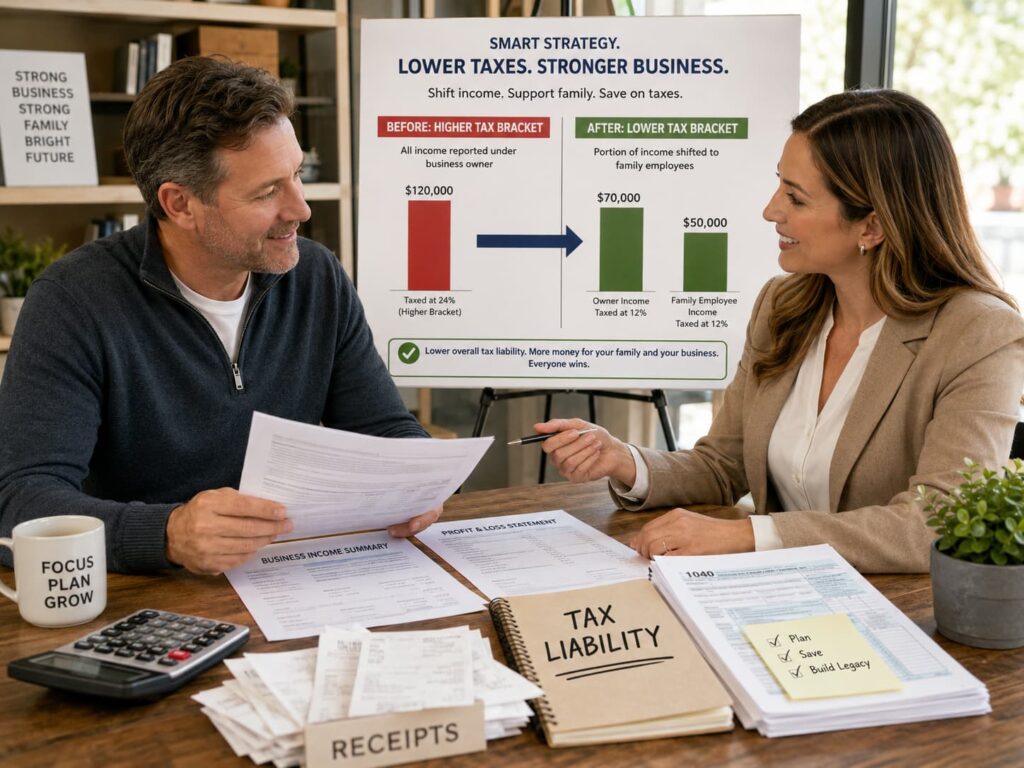
- Shift to a lower bracket: Your child’s wages are taxed to them, often at 0% federal income tax if total income stays under their standard deduction (subject to annual limits).
- Payroll tax relief for parents’ businesses: In a sole prop or qualified all-parent partnership, wages to children under 18 are not subject to FICA, and wages to children under 21 are not subject to FUTA.
- Smart wealth moves: With earned income, your child can contribute to a Roth IRA (up to the annual limit or their earned income, whichever is lower). That’s decades of tax-free compounding from their first job.
Note: “Kiddie tax” rules apply to unearned income (like interest or dividends), not wages.
Legit wages for real work aren’t subject to kiddie tax.
The Paper Trail: What to Keep (So You Can Sleep)
Auditors love documentation. Build a simple, bulletproof file:
- Job description (age-appropriate duties, who supervises, pay rate)
- Employment agreement (one page is fine)
- W-4, I-9, new-hire confirmation
- Timesheets or project work orders + deliverables accepted (signed or saved approvals)
- Proof of payment (ACH/check to the child’s account; avoid cash)
- Work samples (screenshots, photos, files—attach to the project record)
- Year-end W-2 and wage/tax summaries
Paying your child? Pay them, not yourself.
Transfer to a bank account in their name (custodial is fine for minors) to show the money is theirs.
Common Mistakes (Don’t Make These)
- No real work. If they’re “on payroll” but not actually working, you don’t have a deduction. You have a problem.
- Paying as a 1099 contractor. For work you direct/control, your child belongs on W-2.
- Ignoring entity rules. S-Corp/C-Corp wages to kids are subject to FICA/FUTA; sole prop/all-parent partnerships may get the under-18/under-21 relief.
- No documentation. Verbal arrangements don’t help you in an audit. Keep timesheets or project briefs, proof of payment, and year-end W-2.
- Hazardous tasks. Still prohibited for minors, even in family businesses.
- State law blind spots. Missed workers’ comp or payday rules can trigger penalties.
- Overpaying. Keep compensation reasonable for the work and your market.
Step-by-Step Setup (30-Minute Checklist)
- Decide the role (duties, estimated hours, rate).
- Confirm state rules (workers’ comp, minors’ work permits, payday frequency, any hour limits).
- Create a one-page job description and employment agreement.
- Collect W-4 and I-9; complete new-hire reporting for your state.
- Add them to payroll (configure FICA/FUTA based on your entity and their age).
- Set up timesheets or project briefs + acceptance.
- Pay via check/ACH to your child’s bank/custodial account.
- File W-2 at year-end; keep the whole packet in your compliance folder.
- If you want, open a Roth IRA for the child (limited to their earned income or the annual cap).
- Celebrate the first payday and talk about saving, spending, giving—make it a lesson, not just a deduction.
FAQs
Can I hire my 8-year-old?
Yes—if it’s your business (sole prop or all-parent partnership) and the work is non-hazardous and age-appropriate. State rules may add limits.
Do I have to pay minimum wage to my child?
In most cases, yes—minimum wage and overtime rules still apply unless a specific exemption exists. Family exemption mainly addresses child-labor restrictions, not wages.
W-2 or 1099?
W-2. They’re your employee if you control how/when work is done.
Do I have to withhold taxes from my child’s pay?
Follow the W-4. If they expect to owe no federal income tax, they may claim exemption from withholding. FICA/FUTA depend on entity type and age (see above).
What if I’m an S-Corp?
You can still hire your child and deduct wages, but FICA/FUTA apply like any other employee. The big family FICA/FUTA break is for sole props and all-parent partnerships.
What about modeling/appearance fees?
Project-based pay is fine. Keep a project brief, deliverables, and approval in your files—plus proof of payment.
Can my child contribute to a Roth IRA?
Yes, if they have earned income. The max is the annual IRS limit or their earned income, whichever is less.
Ready to Do This the Right Way?
- Free Training: Hiring Your Kids 101 Masterclass: entity rules, pay strategies, documentation templates, and FAQs.
- Need practical tools? Check my shop for small-business finance templates and trainings (including hiring/onboarding resources):
- Need payroll for your kid (and team) that handles W-2s/new-hire reporting?
Use a simple payroll platform so paydays and filings are automated.
Important Notes & Disclaimer
- This guide focuses on U.S. rules. States can impose stricter standards (permits, hours, workers’ comp, break rules). Always check your state’s labor department.
- This article is educational and not individualized tax, legal, or HR advice. Consult your advisor for your specific situation.
Hiring your kids can be a win-win!
Your business gets real help (and a deduction). Your kids learn meaningful skills.
And your family keeps more of what you earn.
Do it right, document well, and let the lessons—and memories—compound!
This transcript was generated from the video for your convenience, but it may contain typos or slight errors due to the transcription process. For the most accurate and complete information, we recommend watching the full YouTube video.
How Much Can I Pay My Kids Tax Free: Hiring Your Kids
Can you really hire your 8-year-old? How about your teenager? This is one of the most common questions that I'm asked, and the truth might actually surprise you. Hi everyone. I'm Jamie Troll, CPA financial educator and big time advocate for small business owners and entrepreneurial parents. And today I've actually got a few special guests that are gonna be joining me to answer a very important question.
What age can you illegally hire your kids? And what are the rules to do it the correct way? Stick around to the end. 'cause I'm gonna share with you the number one biggest mistake that I see business owners making when it comes to employing their kids, even when they are paying them for work in their business.
So can you legally hire your kids? Yes, you can hire them, but the specifics and the rules are going to depend on their age, what they're gonna be doing, and even the entity type of your business. All right, now, this is my son and our first special guest today, miles. Hello. He is. How old are you? I'm 11. He's 11.
He actually helps me out in my business quite a bit, and it's the summer, so we're really kicking off, having more to do, right? Mm-hmm. Yep. So Miles helps me with a lot of different things, including showing up on videos, and he even created an entire bonus lesson for my Hiring Your Kids Toolkit programs, didn't you?
Family Business Tax Benefits: Kids Working in a Small Business
Yeah. All by yourself. So he wrote the whole entire outline. It was about teaching kids about money. Made the presentation. What'd you make it in? I made it. In Canva. In Canva, yep. And animated. It made it, it looked amazing. And then what did you do? And then I shared it. You actually recorded it, didn't you?
The whole thing. Yeah. Yep. He actually recorded it, and all we had to do on our end was edit it and it was fabulous. Did you feel like you learned a lot from that? Mm-hmm. Mm-hmm. It was really fun. Yeah. It was super fun. Yeah, it was super fun. Do you think we should add a little clip from the blooper reel right now?
Yeah. All right. Let's add that in. The four main goals that we have today are, oh gosh, now I gotta look down. Wait, what was I saying before that? I thought you said automatically and I'm just like, that's not work. I don't need, don't forget dab do. All right. Well thanks for joining me, miles. I really appreciate you being here.
And I'm gonna come up with some more things for you to do. I bet you also like being able to work in your PJs, don't you? Yeah. Yeah. Not bad, right? Goody in the ps. Not a bad deal. And we're back. So what exactly are the age requirements for hiring your kids?
Parent's Sole Proprietorship: Family Employees and Child Labor Rules
Well, federally there is an exemption to child labor laws specifically for kids who are working in their.
Own parents' business. Now, this is true for businesses that are sole proprietorships. Maybe you're an LLC that's only owned by one or both parents and not a corporation or a partnership that's owned by multiple parents. In that case, then you are exempt from the federal labor laws and you can employ your child at any age.
Now, if your kids are 14 or over, they can generally work for you no matter what the structure is of your business. However, you do get better tax benefits if they are working for a sole proprietorship. Or an LLC and not a corporation, and that's true if they are a minor under the age of 18. So the best benefits are for minors who are under 18 working for you.
Now, all that said, if you are a corporation and want to employ your child who is under 14, there are ways to do that legally, or if you want to be able to get the best. Tax benefits regardless of their age. There is a way to do that regardless of structure, but there are some added steps.
Sole Proprietorship Tax Breaks: Rules Based on Entity Type
So if you're curious to know more about that, I actually go in depth into this topic in my free masterclass.
So go check it out, jamie charles.com/masterclass. That is the Hiring Your Kids 1 0 1 Masterclass, and you can learn the ins and outs, and we'll go a little bit deeper into this concept. Of what the rules are based on your entity type. So what kind of work can your kids actually do in your business? You might be asking yourself that question.
Now, the rules are that it must be age appropriate. It must be non-hazardous. So even though you may be exempt from the age requirement of the Federal Labor Standards Act, you are not ever going to be exempt from the hazardous activities. So you cannot put your child in a mine. Or on an assembly line. Of course, it's also gonna be something that's actually needed in your business and normal for you to hire someone.
So if you're having them do a task that you would never normally actually hire someone else to do or do yourself, then that probably won't pass the test, and they do really have to work for you.
Reasonable Wage: Pay Your Child for Real Business Work
I'm really big on this. I know a lot of people look at this as an opportunity to put their kids on payroll and pay them and get a tax deduction, and they aren't.
Actually even requiring their kid to work for them, which first of all is not a great lesson for your kids, and second of all is really missing an opportunity to be able to develop skills in your kids. That's what Miles has liked the most about working in the business, is being able to really gain some new skills and learn some new things and feel really proud of what he can do now.
So if you need some examples, little kids doing any kind of modeling, maybe for social media. Or video, like what I'm doing now. My kids are being paid for being in this video. Maybe it's packing swag bags or being a grader if you have an actual brick and mortar place. Those are jobs that are even good for younger people, and then as they get older, you're gonna be able to give them more things to do.
My son does some light graphic design. He does work with presentations and editing and things like that, which have really gained some great skills for him and eventually.
Family Employees: Age-Appropriate Work in the Family Business
Once he's a teen, I might get him into doing more with social media and maybe into learning video editing, which would be a fabulous skill for him to learn.
And this is Nora, my little mini me. And as you can see, she's a little bit younger. How old are you, Nora? Eight. You're eight? Yep. And do you work for mommy? Yeah. Yeah. So Nora does a lot of things. She's got a lot of good skills. So she comes and joins me for my videos. Sometimes she is, uh, modeling for me, basically, uh, for my social media.
If she shows up in pictures and things like that, I do pay her for that. And Nora is great at organization, aren't you, Nora? That's one of her skills. She puts everything in rainbow order and she is a fabulous organizational assistant. So I've utilized those skills, um, and that's what's really neat. It's cool to see the things that your kids gravitate towards and to be able to put them in roles that really help them to hone those skills and the things that are unique about them.
Um, so Nora, what is your favorite part of working with Mommy?
Pay Tax and Income Tax: How Much Should You Pay Your Child?
Um, I like that I get to spend time with you and that you pay me. Those are both important. So literally I'm paying you to spend time with me, kind of. That's kind of nice, right? Yeah. Best of both worlds. And you get to work in your PJs too because it's summer.
All right, anything else you wanna say, Nora, before we leave? Um, no. All right. I love you. Go play, and that's a good segue into the next question, which is, how much should you actually pay your kids? Now remember, the more that you pay them, the more of a tax benefit there will be. However, you do need to have a basis for what you're paying them.
The golden rule is to pay them reasonably for the work they're actually doing in your business. Now, depending on what they're doing, it may come with different rates. So if they're doing administrative work that you would normally pay someone else $15 an hour to do, then maybe $15 an hour is a good rate for that work.
Good Records: Documentation for Family Employees
Or if they are doing modeling or acting for you, that actually might be paid on a per project basis and you could potentially pay them more just based on. What they would be paid if they were to get a modeling or acting job for someone else's business. So that leads us to the next question, which is, what records should you keep?
And the answer is you should keep good records. Again, remember, if you're ever audited, then you're gonna have to prove that they were actually doing work for your business, that that work was reasonable, and that you have it documented in such a way that you can actually get credit for that deduction.
And that means treating them like any other employee. And having the documentation to prove you actually hired them. So we're talking about things like issuing W twos, having some form of time sheet that actually documents the work that they're doing, having an employment agreement as well, and actually having set job descriptions for what they do for your business.
And this is one of those things that can get people into a little bit of trouble when they skip this step.
Tax Breaks: Deducting Wages When You Pay Your Child
I'm a big fan of documenting everything and then you know, you have it. If you are ever in a situation where you get audited, all right, so remember I said I was gonna tell you the number one mistake I see people making, and that mistake is not realizing that when you're paying your kids to do work for you, you can deduct that and it can help shift your income from a higher tax bracket, IE yours, to a lower.
Probably zero tax bracket, which is your child's. Now, I know a lot of people that actually pay their kids, but they don't take it as a deduction, and maybe they just hand them cash from time to time for things and they don't realize how lucrative it can actually be. If you do. Claim this as an actual deduction.
Now, of course there's a cost benefit here, right? So if you are just handing them 20 bucks every once in a while for doing something in your business, it may not be worth getting them set up as an employee of your business.
Pay Your Child Tax Free: Tax Benefits for Small Business Owners
However, if you wanna do something like open a Roth IRA for them or get a bigger tax deduction, or heck even use the money you're paying your child and getting a tax deduction for.
To still pay for things you're already paying for, like private school tuition or sporting event fees or dance competition fees, right? All of that relates to them, and you can use the money that you're paying your child to pay for those things, and it's going to be tax free. So that's the biggest mistake I make, is just not being intentional about it and realizing how impactful this can be if you set it up the right way.
Now, if you wanna dive deeper into paying your kids tax free and doing it legally, definitely make sure to go check out my masterclass all about this topic, where I go deeper into how to do this the right way. You can find that masterclass at jamietrull.com slash masterclass and it's completely free. So go check it out now.
And of course, don't forget to subscribe and leave a note in the comments, do your kids work for you? How old are they? What do you think that they could be doing or are already doing in your business?
Tell me down below, thanks for joining us, and I'll see you next time.