Does “No Tax on Tips” Apply if You’re Self-Employed?
A Complete Guide for Freelancers, Gig Workers & Small Business Owners
Are you self-employed and wondering how the new “No Tax on Tips” law affects you?
You’re not alone.
With the July 2025 One Big Beautiful Bill introducing a tax break for tipped income, many freelancers, gig workers, and small business owners are asking:
Do I qualify—and what should I do now?
Below, you’ll get a plain-English walkthrough of the new up to $25,000 federal income-tax deduction for tips, exactly who it applies to (and who it doesn’t), how to document your tips correctly so you can use the deduction, and common pitfalls (like confusing service charges with tips).
You’ll also see a practical checklist and examples so you can estimate your potential savings.
If you want the broader small-business picture from this law, watch my full summary here (I cover the other wins and watch-outs you should know about):
➡️ Complete Summary of the One Big Beautiful Bill Act
Prefer the source? Here’s the bill text (jump to Section 70201 – No tax on tips):
➡️ Read the Big Beautiful Bill
What Exactly Changed? The $25,000 Tip Deduction—in Plain English
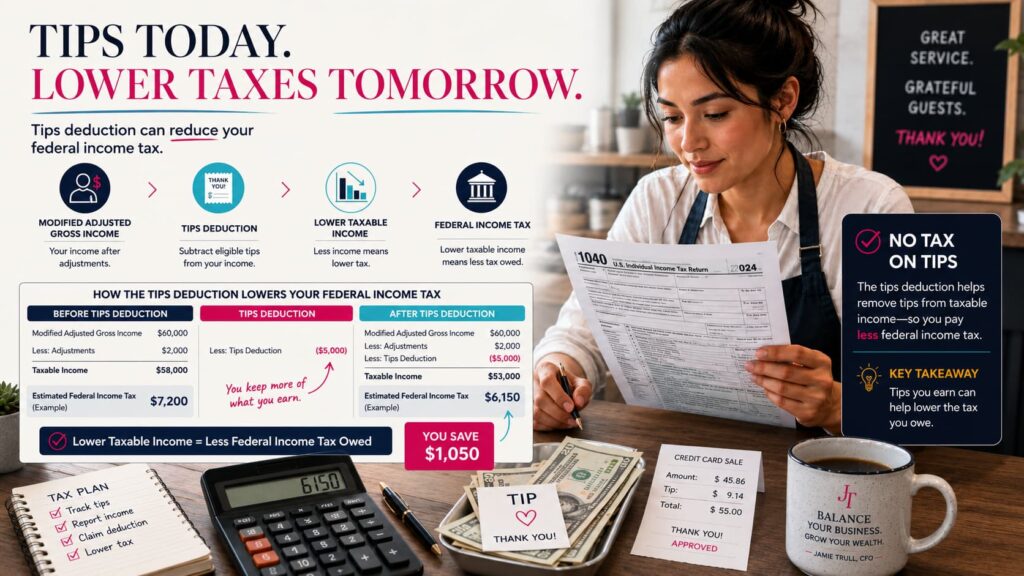
- What it is: A new federal income-tax deduction of up to $25,000 for qualified tips you personally receive.
- What it isn’t: It does not eliminate self-employment tax (for sole proprietors/LLCs) or payroll taxes (Social Security & Medicare) on tips. Those still apply.
- When it starts: Applies now (2025 tips).
- Income phaseout (for your own tips): The deduction phases out as your taxable income rises above $150,000 (single) or $300,000 (married filing jointly).
- Employees you pay: If you have employees who receive tips, your income does not phase out their benefit.
Key takeaway: Think of this as an income-tax break on tips—not a full tax exemption. You’ll still owe SE/payroll taxes on your tips.
Who’s In—and Who Isn’t
The law is designed for occupations that “customarily and regularly” received tips as of 12/31/2024. Two big categories are specifically called out:
- Food & beverage served/delivered in settings where tipping is customary (servers, bartenders, delivery)
- Personal care (barbering/hair, nails, esthetics, massage, spa staff)
The Treasury/IRS will publish an official list of occupations that qualify based on that date. Until then, use industry norms and be conservative.
Generally included (when tipping is customary):
- Servers, bartenders, baristas, food delivery
- Hairstylists, barbers, nail techs, estheticians, massage therapists
- Many gig workers where customer tipping is the norm (see section on gig platforms below)
Generally excluded:
- Specified Service Trades/Businesses (SSTBs) like coaching, consulting, accounting, and other advisory/skill-based professions where the principal asset is the owner’s/employee’s skill/reputation
- Non-monetary “tips” (gift baskets, concert tickets, etc.)
- Mandatory service charges (these are typically wages, not tips—details below)
“Cash Tips” ≠ Only Cash: Do Card/App Tips Count?
Yes. The law’s definition of “cash tips” includes tips paid in cash or charged (i.e., credit card/app). It also includes tip-pool distributions to employees.
What doesn’t count: Non-monetary gifts. The deduction is about money tips only.
Self-Employed? How to Track Tips So You Can Actually Claim the Deduction
If you’re a sole proprietor/LLC who personally receives tips, clean separation is everything. If your tips are jumbled with service fees or lumped in with regular revenue, you’re likely to lose the deduction at tax time.
Set this up now:
- In your POS/accounting:
- Create distinct income lines: “Service/Item Revenue” and “Tips (Customer-Paid)”.
- Configure your POS so tips are itemized on daily/weekly/monthly reports.
- Cash tips:
- Keep a simple tip log (date, client/job, amount, payment type, deposit date).
- Deposit regularly, and code deposits to Tips in your books.
- Card/app tips:
- Save platform settlement reports that show tips separately from base charges and fees.
- Monthly routine:
- Reconcile your bank deposits to POS/platform reports and your Tips account in bookkeeping.
Need a bookkeeping system that makes separating tips straightforward and keeps reports ready for tax time? I rounded up approachable tools here:
➡️ DIY Accounting Tools I Recommend
Employers With Tipped Staff: Payroll, Withholding & W-2s (Made Simple)
If you have employees who receive tips:
- Tips are taxable wages for FICA (Social Security/Medicare). You must withhold and remit these.
- Employees should report tips to you (and your payroll system) on a defined cadence.
- W-2s must reflect wages + tips accurately, including any allocated tips.
- Expect potential form updates as the IRS implements this law.
To keep it smooth and compliant—especially across multiple states—use payroll built for tipped employees that automates federal/state filings, new-hire reporting, and W-2 prep:
➡️ OnPay (Payroll & HR) — my favorite payroll for small teams with tipped workers
(Check the page for any current signup bonus available via my partner link.)
Tip policy to document and share:
- How/when employees report tips
- Tip pooling rules (if applicable)
- Clear distinction between service charges vs. tips (and how each is treated in payroll)
- Manager review process every pay period
Gig Workers (Uber, DoorDash, Instacart, etc.)
If you drive, deliver, or shop and receive tips through an app:
- Download monthly statements and year-end summaries; confirm tips are itemized.
- If your 1099 doesn’t break tips out, your platform reports + bank records are your proof.
- Remember: The $25,000 deduction is federal income tax only. You’ll still owe self-employment tax on tips.
Service Charges vs. Tips: Don’t Mix Them Up
This trips up a lot of businesses:
- Voluntary tip: Customer chooses the amount. Qualifies for the deduction (subject to all other rules).
- Mandatory service charge (e.g., automatic 18% “service fee”): Generally treated as wages/business income, not a tip. Does not qualify as a “tip” for this deduction.
Action: Ensure your POS and receipts clearly label tips versus service charges. If you pool service charges and distribute them, that doesn’t convert them into “tips.”
Phaseouts, Caps & Real-World Examples
- Cap: Up to $25,000 of qualified tips can be deducted against federal income tax.
- Phaseout (for your own tips):
- Single: begins at $150,000 taxable income
- Married filing jointly: begins at $300,000
“Taxable income” is after your business deductions—it’s not your gross receipts. Look at your Form 1040 taxable income line from last year for a ballpark.
Examples (illustrative):
- Independent Esthetician
- Gross revenue: $85,000; Expenses: $30,000 → Net profit: $55,000
- Tips received (card/cash): $12,000
- Likely qualifies as personal care; below phaseout threshold
- Potential deduction: $12,000 off federal income tax (still owe SE tax on the $12k)
- Rideshare Driver
- Net profit: $40,000; Tips: $6,500 (in-app)
- Customary tipping; below phaseout
- Potential deduction: $6,500 off federal income tax (still owe SE tax on $6.5k)
- Restaurant Owner With Tipped Staff
- Owner doesn’t personally receive tips; employees do
- Employees can benefit (subject to their own income/limits)
- Owner’s deduction applies only if owner personally receives tips as an employee and is under phaseout thresholds
Action Checklist: What to Do This Week
If you personally receive tips (self-employed or employee):
- ☐ Create a separate “Tips (Customer-Paid)” income category in your books
- ☐ Configure your POS/app to itemize tips on reports
- ☐ Start a simple tip log for cash tips (date, client, amount, deposit date)
- ☐ Save monthly platform statements and year-end summaries
- ☐ Reconcile deposits to Tips monthly so your totals are ready for tax time
If you employ tipped workers:
- ☐ Adopt a written tip policy (reporting, pooling, service-charge definitions)
- ☐ Use payroll built for tips with automated filings & W-2s:
➡️ OnPay Payroll - ☐ Train managers to review tip reports each pay period
- ☐ Audit your POS labels (tips vs service charges) now
If your bookkeeping needs a refresh:
- ☐ Choose an accounting tool that makes separating tips easy and reporting clean:
➡️ Accounting Tools I Recommend
FAQs
Do credit card tips qualify, or is it cash only?
They qualify. The law’s “cash tips” definition includes charged/card tips and tip-share distributions.
Does this wipe out self-employment/payroll taxes on tips?
No. It’s a federal income-tax deduction only. SE/payroll taxes still apply.
My industry wasn’t a tipped industry before 12/31/2024—am I out?
The IRS will publish a list based on customary practice as of that date. If tipping wasn’t customary, you may be out. Track anyway—guidance evolves.
We add an automatic “service fee” and allow optional tips—can we treat the fee as a tip?
Generally no. A mandatory service charge is not a tip. Keep them separate.
Our household taxable income is ~$320k MFJ—do my tips still get the deduction?
The deduction phases out above $300k MFJ. You may get partial or no benefit depending on the calculation—ask your tax pro.
I’m an S-Corp owner—does anything change?
If you personally receive tips as an employee of your S-Corp, the same income-tax deduction rules apply (subject to phaseouts). Tips are still subject to payroll taxes in payroll.
Relevant Resources (Only What You Need for This Topic)
- 🎥 Full Small-Business Overview of the One Big Beautiful Bill (for broader context)
- 📄 Read the Big Beautiful Bill (Section 70201 – No Tax on Tips)
- 🧾 DIY Accounting Tools (to separate & report tips cleanly)
- 🧑🍳 OnPay Payroll & HR (best-in-class for teams with tipped employees)
Final Word
The new No Tax on Tips provision can be a meaningful win for self-employed pros and employees in tipped industries—but only if you track tips separately and understand what qualifies. Get your POS labels right, keep service charges distinct from tips, and document everything. For employers, tighten up payroll and tip policies now so your team can benefit and your business stays compliant.
Want ongoing updates—especially when the official IRS tipped-occupation list drops—and more practical how-to’s for your business finances? Subscribe to the channel and keep this guide handy.
Disclaimer: Educational purposes only. Not tax, legal, or accounting advice for your specific situation. Consult your professional advisor.
Youtube video:
Transcript Disclaimer:
This transcript was generated from the video for your convenience, but it may contain typos or slight errors due to the transcription process. For the most accurate and complete information, we recommend watching the full YouTube video.
No Tax on Tips and the Big Beautiful Bill Act
Unless you've been living a little bit under a rock, you probably have heard about the new bill that was passed in July of 2025. That includes a provision for no tax on tips. Now, if you're self-employed or a small business owner, you might be wondering how and if this affects you. So today we're gonna dig into this provision in the one big beautiful Bill.
Yes, that's. The real name of this bill and talk about how this impacts anyone who is employing themselves. Maybe you're a gig worker or a contractor, or a self-employed, service-based, business professional, or maybe you have your own small business and you have employees of your own. We are gonna talk about that all here today.
Now real quick, if you wanna dive into a summary of more of the provisions that impact small business owners and self-employed individuals from this big, beautiful Bill, then check out this video where I did a full summary for you. But here today, I specifically want to talk about this no tax on tips, because this is the one that I've seen probably the most misinformation around.
Floating out there in the business community. And whenever I see misinformation, I like to go directly back to the source. So I've linked below the actual text of the full bill. Yes, it is over 800 pages. No, you do not need to read it all. However, it is always a good idea to go back to the source information if you're uncertain.
Federal Income Tax and Income Tax Withholding
So you can see here it is a pretty long bill. It covers a lot of different stuff. Uh, some of it positive for business owners, some of it not so much, but. It is a lot of different things that are covered within here, so you can take a look through. It's great bedtime reading if you so choose, but here we are.
I finally found it. Let's go to section 7 0 2 0 1, which is no tax on tips. In fact, most of this section might be interesting to you. This also talks about no tax on overtime car loan interest and these new Trump accounts that are coming out. I'm not gonna talk about that in this video, but make sure to subscribe for future videos where I'll dive into it more.
So everything we're gonna talk about here today is coming from section 7 0 2 0 1, so you can follow along if you'd like. So first of all, let's talk about what it is, and then we'll talk about who it's for now, what it is. You can see here, in general, the amount, the limitation is $25,000. So potentially you could deduct up to $25,000.
In tips from your income tax. Now this is specifically related to federal income tax that you are due to pay. This does not apply to payroll taxes. Okay? So that means social security and Medicare also known for those of you who are self-employed as self-employment taxes. So this does not exempt your.
Income Limits for Received Tips
Tips from those taxes. That's really important to say. So when we talk about no tax on tips, it's really important to note we are talking about federal income tax only. Then we can jump down here or we can see essentially where we're talking about. What the limitation is for your income. So this may scope out some self-employed individuals and small business owners potentially from this, uh, because if you make more than $150,000 or married filing jointly of $300,000, this deduction will start to go away.
Now, that's for the tips that you personally receive. That's not true when we're talking about employees. So if you're a small business owner. And you have employees, your income won't phase out their deduction. However, if you personally are getting tips as an employee of your business or as someone who is self-employed, then that is the income limits that it will start phasing out at.
Okay, so what are qualified tips? Let's talk about that for the purpose of this section. Qualified tips means cash tips received by an individual in an occupation, which customarily and regularly received tips on number four. Last year as provided by the secretary. Okay. A few things to note here. First of all, this may be something that is causing people to trip up.
Qualified Tips and Cash Tips
This is where I've seen a lot of misinformation. Some people think that cash tips means literal cash. They have to hand you bills and it can't be like a credit card receipt and that wouldn't count. That is not true and how I can prove it's not true. And the reason that people are saying this is 'cause they don't keep reading.
Right? It's always important to keep reading. Here it actually defines what cash tips actually means. So for purposes of paragraph one, which is the one we just read, right? The term cash tips includes tips received from customers that are paid in cash. Or charged. Okay. Or charged. And in the case of an employee, tips received under any tip sharing arrangement.
Okay, so important to note this or charged is specifically called out. So when you see people saying it's just cash tips. Yes. But cash for from the purpose of the IRS, they see both, you know, credit card charges and cash is the same. The reason that it's denoting cash tips and that it even puts that in there is that it doesn't apply to tips that are maybe like they gifted you concert tickets.
Like, I don't know how many, how many people are getting gifted concert tickets for, uh, a table that they waited on or for, um, you know, somebody that they're giving a massage to. But that's essentially what it's talking about is if you receive gifts that those are still taxable. I'm not sure how many of y'all are.
Regularly Received Tips and Tipped Industries
Actually claiming your gifts anyway. So I don't really think that this is gonna impact you much, but this does apply only to monetary tips, which come to think of it might have been a better way for them to say this. So let's go back to this statement here, 'cause I think this is important as well.
Individual in an occupation which customarily and regularly received tips on, or before December 31st, 2024. This might make you think it's for tips received before December 31st, 2024. That's not what that means. It just means for industries that were already heavily tipped industries before the end of last year, those are the types of industries that they're talking about.
The reason that they're putting that in there is, my guess is that they know that by having this new law, a lot of industries are gonna become more tipped industries, right? All of a sudden, everybody's gonna be a tipped industry because they're gonna wanna take advantage of this. No tax on tips. So that's what they're trying to prevent to say like, you know, we can't make every industry.
A tipped industry. So we're gonna look at the ones that were already that kind of industry before this bill passed. Now there's a lot of ambiguity around that, so let's dig a little bit deeper into what they actually mean as far as what types of industries would actually qualify for this. So here's where you're gonna find that application only to certain lines of business, right?
Qualified Tips for Food, Personal Care, and Services
Again, paragraph one, which we've read earlier. In applying paragraph one, there shall be taken into account only tips received from customers or clients in connection with the following services. The providing, delivering, or serving food or beverages for consumption. If the tipping of employees delivering or serving food or beverages by customers is customary and providing any of these types of services, barbering or hair care, nail care, aesthetics, body and spa treatments.
So basically personal care type of activities. Now, before you sigh and say, oh, oh, I guess I don't qualify for this because you're not in food service or personal care industry, hang on a minute, because. While it does say that, it was basically saying these are pretty much definitely going to qualify. So we're gonna go ahead and put that in here.
However, we know that there is more. So you can see, if you come down to this paragraph H, it gives you more information about what's coming. So it says. Publish lists of occupations, traditionally receiving tips no later than 90 days after the date of enactment of this act. So this would be about October 2nd, the Secretary of the Treasury shall publish a list of occupations which customarily and regularly receive tips.
On before December 31st, 2024. So essentially they are going to tell us who will qualify, and it will be broader than what I just read. Now, that list doesn't exist yet, but I'm curious to see what's gonna come from it.
New Deduction for Self Employed Workers
I will say in my experience, oftentimes when the IRS or the Treasury releases some guidance.
It sometimes causes more questions than answers. So I fully am prepared for the what abouts, because it's not going to include everything, but that's what I'm here for. So if you want to make sure to subscribe to this channel, because when this comes out, I'll make sure to, I'm gonna try to remember actually to put it on this actual video down below.
If you're watching this after October 2nd and you don't see a list posted in the description down below, comment to remind me to come back here and do that, assuming that they meet their own deadlines, which we will see, but hopefully they'll have that list out by early October because this does apply to this year.
Some of this stuff in the One big Beautiful Bill applies to 2026 and beyond. This provision, along with the overtime provision does start this year, meaning tips that are being received this year could qualify. For this tax deduction. Now, the big question that I know that you have, I'm self-employed. Does this apply to me?
Probably, right? Again, if you fall into these categories, the categories that they're gonna come out with, right? But let's just say you're already safely in one of these categories. Maybe you are a, uh, esthetician and you have your own salon suite that you work out of and you charge customers and all of those things, and they customarily will tip you above and beyond your normal pay for services.
Own Taxes and Federal Income Tax for Self Employed Tips
Then yes, this would apply to you. Now again, it's only gonna get you out of income taxes and not self-employment taxes, but that's better than nothing. And of course, the other thing that could trip you up is that gross income limit. So again, if your income, and remember when it's talking about this from a self-employed standpoint, your income is your profit.
It's not the total amount of revenue that you take in. So you can deduct your expenses in coming up with your profit when figuring out if your total. Taxable income exceeds that $150,000 or $300,000 married filing jointly. And remember, they're gonna add up all your different income sources. So that's how they're gonna determine that.
So you can take a look at your old tax return and see what your taxable income was to get an idea of whether or not this is something that would apply to you or if you would be phased out of it. However. It's likely that unless you're a super high earner, you are probably going to get some benefit from this.
So what does that mean for you? That means you need to get really good at documentation. You may not actually be documenting in your system what was an actual, you know, fee for service versus the tip that they gave you on top of it, right?
Income Tax Withholding and Documentation for Cash Tips
So if that's all lumped together, let's say in your accounting system.
It's gonna make it a lot harder in order to see what your deduction will be. So what I would suggest for right now is just making sure that you have it set up where you can see tips separately from the base amount charge to customers. And as long as you can pull that out of your accounting system or your point of sale system, then you should have what you need come tax time.
Now, let's say you're a 10 99 contractor. Is this gonna apply? Yes, I assume this will apply to, um, gig workers, uh, people who are Uber drivers, things like that. I would guess that this would apply because to me those will probably be on the list of customarily tipped type of professions. I know I typically tip my taxi driver or my Uber driver, right?
So if you are a gig worker, maybe you're delivering for DoorDash, right? I would think that those would end up getting scoped in. Again, we will see when that list comes out. But if that's you, right. You are gonna want to make sure that you are capturing those things separately as well, and my hope is that they will add a box on the 10 90 nines that you get, that it will show tips separately, right?
Federal Income Tax Withholding and 1099 Tips
That will make it a lot easier. Right now it all is combined into box one on your 10 99 neck. However, I'm hoping that the IRS will realize that you need a little bit more information. Then that in order to get this deduction and require employers to then split those things out. But I'm not sure if they will.
And if you're an employer, that's something to keep in mind too, that they may split this out. So you need to make sure that you have access to that information and can split out between regular wages and tips on those 10 90 nines that you send. Or W twos that you send to your employees. So my best advice at this point is just to set up a system that works for you to track all of this so that you can sense check if you're getting a 10 99, whether they did it correctly, or maybe if the 10 99 doesn't include tips that you know how much you actually got in tips so that you can take that deduction.
So all that is to say is that yes, if you are self-employed or if you're a small business owner that personally receives tips and they fall into the rules. Stipulated within this bill and into the professions that will be coming out later this year. Then yes, this applies to you as well.
Income Tax Limits and Who No Tax on Tips Does Not Apply To
And if you're someone who has employees, this will apply to them too.
So who doesn't this apply to? Well, we know for a fact, even without the list of professions, that there are certain businesses that are not part of this, and that is anyone who is a specified service trader business. So that means coaches, consultants, accountants. Things like that generally are not going to be in the scope of this.
No tax on tips. So if you're curious to know what an SSTB is, and if you qualify as one, here's the list that the IRS gives of who SS TBS typically are. And it's important to note. This one is a pretty big catch all. Any trader business where the principal asset is the reputation or skill of one or more of its employees or owners.
Um, this tells you what that means. So take a look at this list and know that more information is going to be coming out hopefully in early October if they follow their own deadlines for when this is supposed to be released. Thanks for joining me. I hope that this was helpful. Make sure to subscribe for more because I will be giving updates and talking about more important tax parts.
Of this one big, beautiful bill and how it might impact you as a self-employed individual or a small business owner. And thanks so much. Make sure to like and subscribe and I'll see you next time.