Profitable On Paper But Feel Like You’re Operating At a Loss?
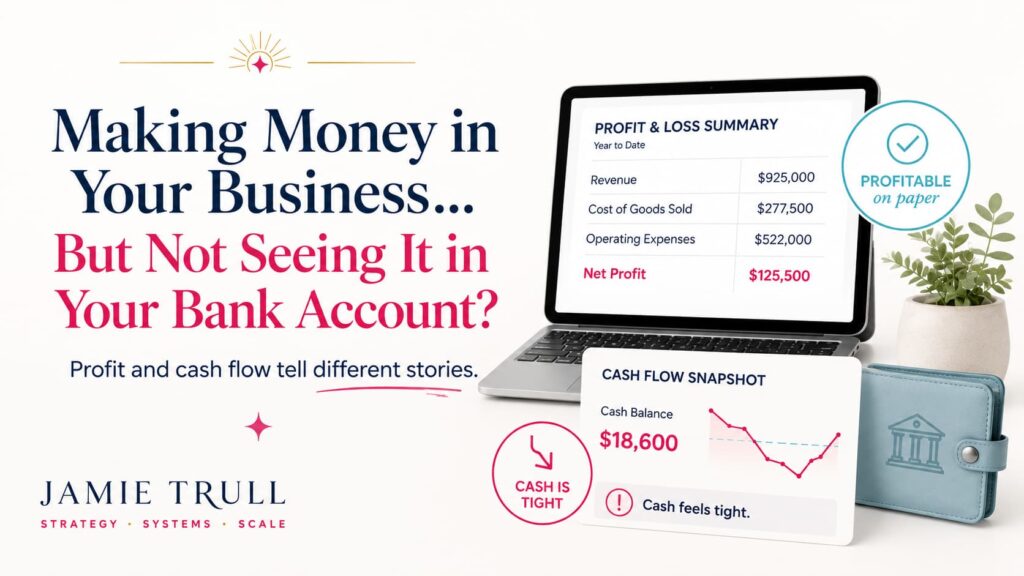
Are you making money in your business but still not seeing it in your bank account?
You’re not alone, and you’re not doing anything wrong.
In this limited-time replay of the Profit Smarter Masterclass, CPA and profit strategist Jamie Trull walks you through the real reason your business isn’t as profitable as it should be… and what to do about it.
In this article, I’ll distill the masterclass into a practical, financial roadmap you can take action on today. You’ll learn:
- Why revenue ≠ profit ≠ cash (and why that mismatch keeps you stressed)
- How to pay yourself consistently without wrecking cash flow
- The biggest money traps entrepreneurs fall into—and how to sidestep them
- The five core profit levers you can pull to increase profit without burning out
- A simple weekly Money Monday routine and mini KPI dashboard to stay in control
- How small tweaks, stacked together, can compound into big profit gains
🚨 Encore available for a short time. Don’t wait to watch the replay when it drops on YouTube.
Fast Links (relevant to this topic)
- 📘 Pre-order Hidden Profit by Jamie Trull + get $300+ in bonuses (companion workbook, Profit Lever diagnostic, 90-minute CFO Year-End Reset workshop ticket, and more).
The Core Problem: Revenue ≠ Profit ≠ Cash
Most business owners get three numbers tangled up:
- Revenue: What you sell or bill.
- Profit: What’s left on paper after expenses (the number that drives taxes).
- Cash: What’s actually in your bank accounts.
You can absolutely be “profitable” and still feel broke.
Why?
Because profit includes timing, revenue and non-cash adjustments (what Jamie affectionately calls “accounting funny business”).
Revenue projections and expected revenue forecasts may not always align with actual performance.
Cash measures reality—when money actually moves.
The Leaky Bucket Analogy
Picture your business as a bucket.
Water in = sales. Holes = expenses, debt payments, owner draws, inventory, and taxes.
If you only try to “turn up the faucet” (sell more) without patching the holes, you’re still going to end up empty, and exhausted.
The masterclass shows how to patch leaks first, then pour on growth so every new sale is meaningfully profitable.
The Simplest Profit Formula (No Jargon)
Forget the spreadsheet labyrinth. At the decision level, profit is:
Profit = (Number of Sales) × (Base Price + Add-Ons) − (Direct Costs + Indirect Costs)
Every term in that equation is a profit lever you can pull.
Adjusting any lever changes the math in your favor.
Adjusting multiple levers (even slightly) creates compounding improvements in your business profitability.
We’ll break all five down next.
The Five Profit Levers (and How to Pull Each One)
1) Volume (Sell More of the Right Thing)
What it is: The number of sales. It’s the “more” lever—and the one most people pull first.
The trap: You can’t fix a profitability problem by only selling more.
Selling more of an unprofitable offer just accelerates burnout.
Do this instead:
- Optimize margins first, then scale.
- Add deposits/milestones and shorter terms for expected income (Net-7/14) to speed up collections.
- Turn ongoing work into recurring auto-billing so you don’t chase invoices.
Quick win: Before turning up marketing, confirm your offer’s gross margin (Revenue − Direct Costs) ÷ Revenue is where it needs to be.
Fix that, then scale.
2) Price (Charge for the Value You Deliver)
What it is: Your base price for the product/service.
Reality check: Raising price is often the fastest lever—if you connect it to value and positioning.
Do’s:
- Know your true costs, including the market value of time to deliver.
- Price so you could afford to hire someone to help without going underwater.
- Test increases with new customers first or grandfather legacy clients.
- Consider tiered packaging so value is obvious at each level.
Don’ts:
- Don’t set price just to “beat competitors.” You don’t know their margins. You want to execute upon informed decision making.
- Don’t underprice to lower expectations. That invites scope creep and resentment.
- Don’t raise price without a clear story about the outcome and differentiation.
Quick win: Audit your offers. If you can’t pay a competent contractor to deliver and still earn owner profit, your price is too low. Adjust or re-scope.
3) Average Transaction Value (ATV): Smart Add-Ons & Bundles
What it is: How much a buyer spends per purchase, including upgrades and add-ons.
Why it matters: Small upsells across many customers create big profit with no new leads.
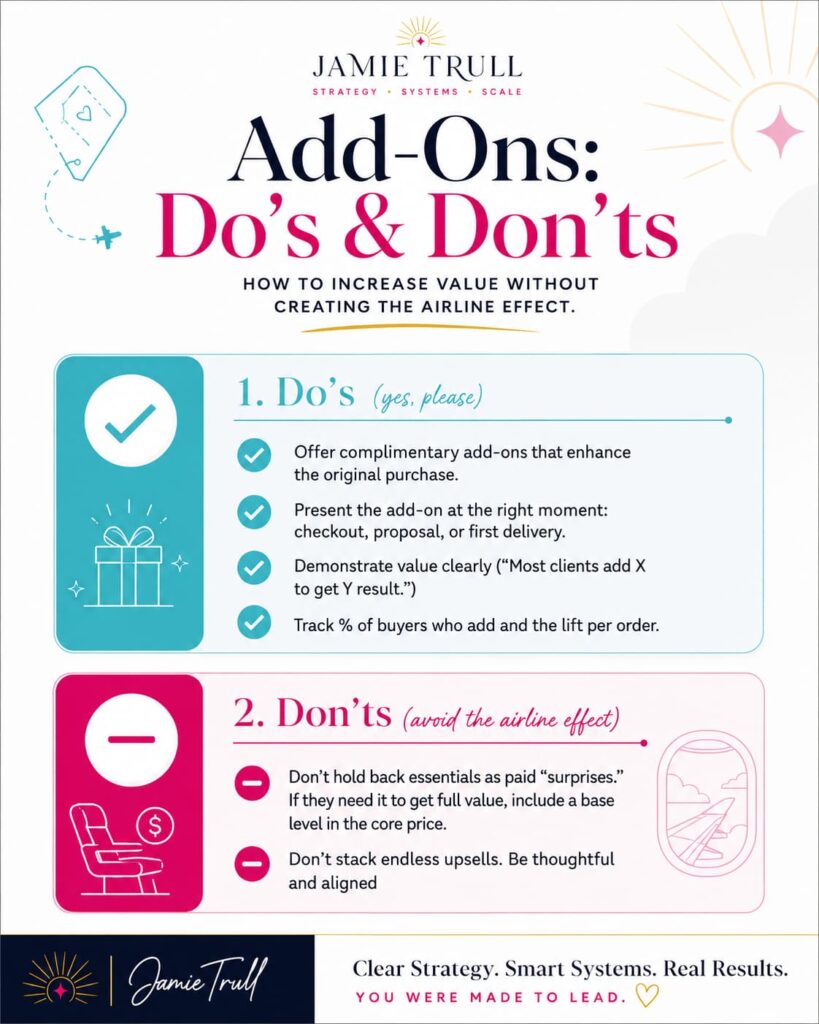
Do’s (make it a “yes, please”):
- Offer complimentary add-ons that enhance the original purchase.
- Present the add-on at the right moment: checkout, proposal, or first delivery.
- Demonstrate value clearly (“Most clients add X to get Y result.”)
- Track % of buyers who add and the lift per order.
Don’ts (avoid the airline effect):
- Don’t hold back essentials as paid “surprises.” If they need it to get full value, include a base level in the core price.
- Don’t stack endless upsells. Be thoughtful and aligned.
Quick math: If 20% of customers add a $20 upgrade, ATV rises by $4. If you lift either the take rate or the upgrade price, the effect compounds.
4) Direct Costs (Lower the Cost to Deliver)
What it is: Costs that move with each sale: raw materials, fulfillment, contractor hours to deliver the work, payment processing on the transaction, etc.
Product-based wins:
- Re-source materials; negotiate vendor terms or bulk pricing for inventory costs(mind cash flow).
- Optimize packaging and shipping without hurting perceived quality.
- Improve yield (fewer defects/returns).
Service-based wins:
- Standardize and templatize deliverables.
- Introduce checklists and SOPs to reduce rework.
- Use tools that speed delivery without lowering quality.
Quick win: Map one offers delivery step-by-step.
Circle steps you can eliminate, automate, or delegate.
The hours you save per project are direct cost savings.
5) Indirect Costs (Overhead You Can Actually Control)
What it is: Tools, admin, rent, general marketing. Costs that don’t move one-for-one with each sale.
Where to look first:
- Subscription creep: Calendar, scheduling, storage, design tools, legacy apps.
- Duplicative tools: Consolidate features into one platform where it makes sense.
- Unused seats: Reduce licenses to active users only.
- “Set and forget” spend: Auto-renewals and stale campaigns.
Quick win: Do a 90-day expense audit.
Cancel or pause anything you didn’t use.
If you’re unsure, pause for a month. If nothing breaks, keep it off.
How Small Tweaks Compound (A Walk-Through Example)
Let’s bring the masterclass math to life.
Imagine an online shop:
- 500 sales/month
- $50 base price + $5 average add-on
- Direct costs = 60% of revenue
- Indirect costs = $9,000/month
Starting point:
Revenue = 500 × ($50 + $5) = $27,500
Direct Costs (60%) = $16,500
Indirect Costs = $9,000
Profit = $2,000 (≈ 7% margin)
Now, make four modest changes before you chase more volume to improve your financial future:
- Raise base price 10% ($50 → $55)
- Lift average add-on by $5
- Cut direct costs to 50% (sourcing + efficiency + pricing)
- Trim indirect costs by 10% (subscriptions/admin)
Then add just 10% more expected sales (via better terms/collections and focused marketing).
Forecasting revenue: 550 × ($55 + $10) = $35,750 (≈ +30%)
Direct costs (50%) = $17,875
Indirect costs (−10%) = $8,100
Profit ≈ $9,775 (≈ 27% margin)
That’s a ~389% increase in dollar profit from small, stackable tweaks. Not a heroic hustle sprint.
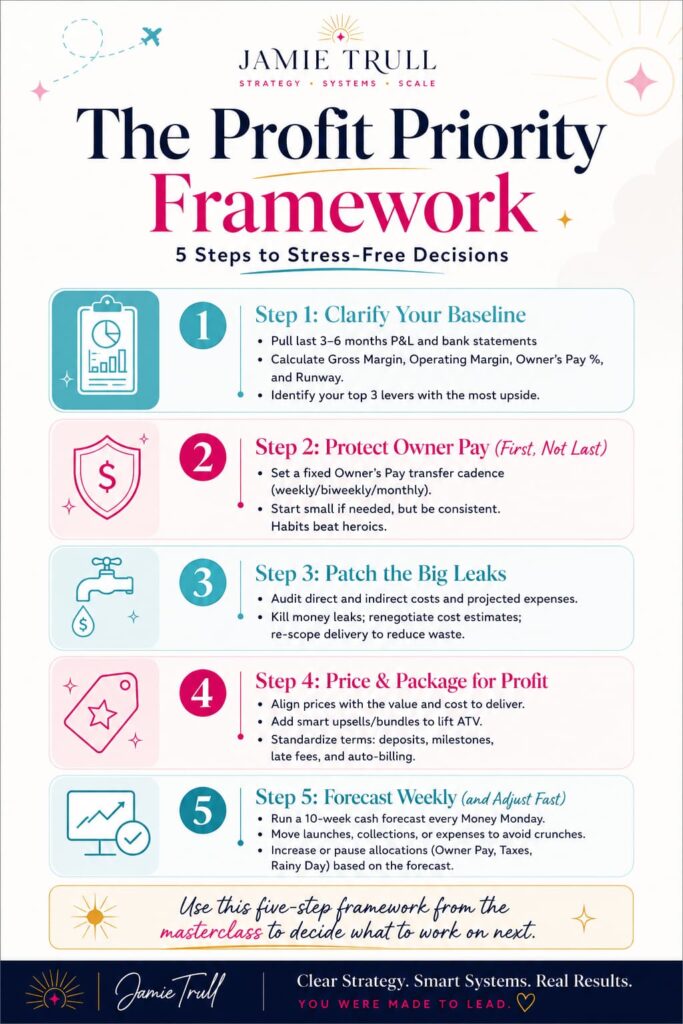
The Profit Priority Framework (5 Steps to Stress-Free Decisions)
Use this five-step framework from the masterclass to decide what to work on next:
Step 1: Clarify Your Baseline
- Pull last 3–6 months P&L and bank statements
- Calculate Gross Margin, Operating Margin, Owner’s Pay %, and Runway.
- Identify your top 3 levers with the most upside.
Step 2: Protect Owner Pay (First, Not Last)
- Set a fixed Owner’s Pay transfer cadence (weekly/biweekly/monthly).
- Start small if needed, but be consistent. Habits beat heroics.
Step 3: Patch the Big Leaks
- Audit direct and indirect costs and projected expenses.
- Kill money leaks; renegotiate cost estimates; re-scope delivery to reduce waste.
Step 4: Price & Package for Profit
- Align prices with the value and cost to deliver.
- Add smart upsells/bundles to lift ATV.
- Standardize terms: deposits, milestones, late fees, and auto-billing.
Step 5: Forecast Weekly (and Adjust Fast)
- Run a 10-week cash forecast every Money Monday.
- Move launches, collections, or expenses to avoid crunches.
- Increase or pause allocations (Owner Pay, Taxes, Rainy Day) based on the forecast.
Your “Money Monday” Routine (15–20 Minutes)
- Update expected inflows (by client/date) and estimate costs outflows (by category/date) for the next 8–10 weeks.
- Spot any shortfalls 2–4 weeks ahead—when you still have options.
- Run your allocations (Owner Pay, Taxes, Rainy Day, etc.).
- Send invoices, trigger reminders, and collect past due.
- Trim a subscription or downgrade something every week until bloat is gone.
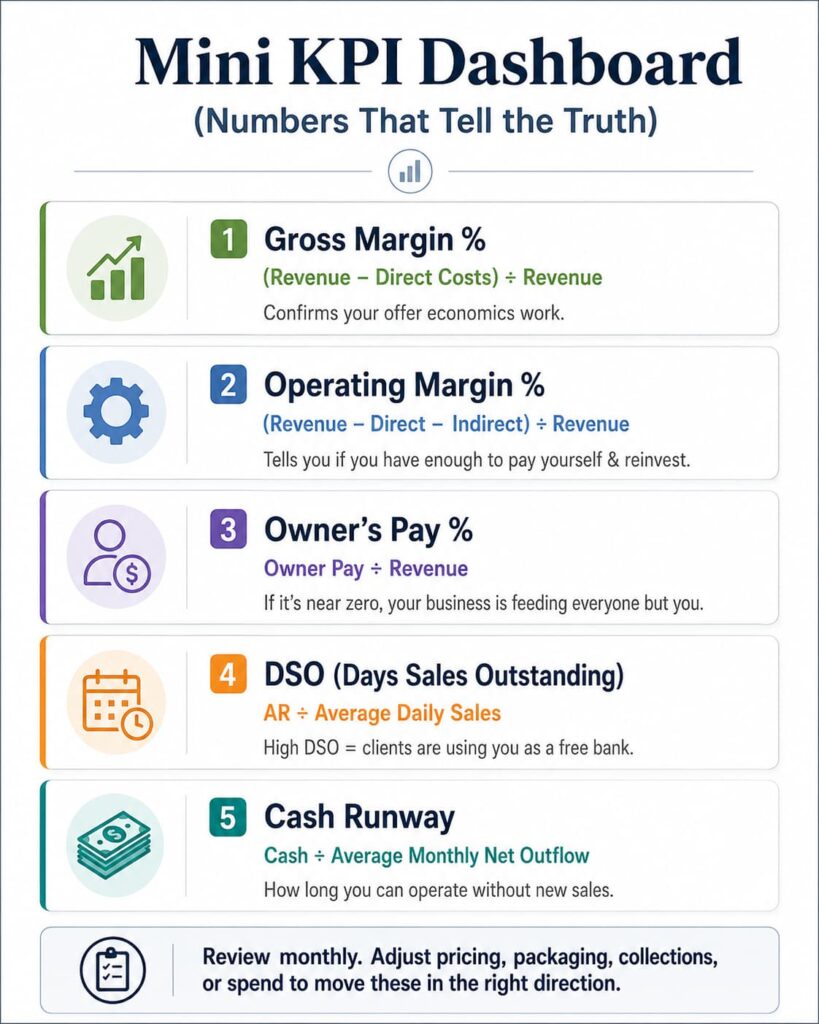
Mini KPI Dashboard (Numbers That Tell the Truth)
- Gross Margin % = (Revenue − Direct Costs) ÷ Revenue
Confirms your offer economics work. - Operating Margin % = (Revenue − Direct − Indirect) ÷ Revenue
Tells you if you have enough to pay yourself & reinvest. - Owner’s Pay % = Owner Pay ÷ Revenue
If it’s near zero, your business is feeding everyone but you. - DSO (Days Sales Outstanding) = AR ÷ Average Daily Sales
High DSO = clients are using you as a free bank. - Cash Runway = Cash ÷ Average Monthly Net Outflow
How long you can operate without new sales.
Review monthly. Adjust pricing, packaging, collections, or spend to move these in the right direction.
Frequently Asked Questions
Q: If I raise prices, won’t I lose clients?
A: Possibly—but if your price reflects value and delivery gets more efficient, you can earn more while serving fewer clients. Test on new clients first and refine your messaging.
Q: How big should my upsell be?
A: Start with something that adds obvious value at 10–25% of the base offer. Track take rate and lift. Increase only if satisfaction stays high.
Q: How much overhead is “too much”?
A: There’s no universal %—but every tool should either save meaningful time or support revenue and revenue forecasts. If it doesn’t, pause it.
Q: What if my work is very custom?
A: Standardize the parts you repeat. Templates, checklists, and milestone billing still apply—and usually improve client experience.
Q: How do I pay myself when cash is inconsistent?
A: Protect a baseline Owner’s Pay amount each month. Use your forecast and a Rainy Day buffer to smooth the dips.
The Mindset Shift: Work Smarter, Not Harder
You don’t need to grind for bigger revenue to feel safe. You need a simple system that pays you first, patches cash leaks, and turns every new sale into meaningful profit. That’s how you avoid burnout and build a business that funds your life—and your purpose.
And if you want the step-by-step support to implement everything you learned in the masterclass…
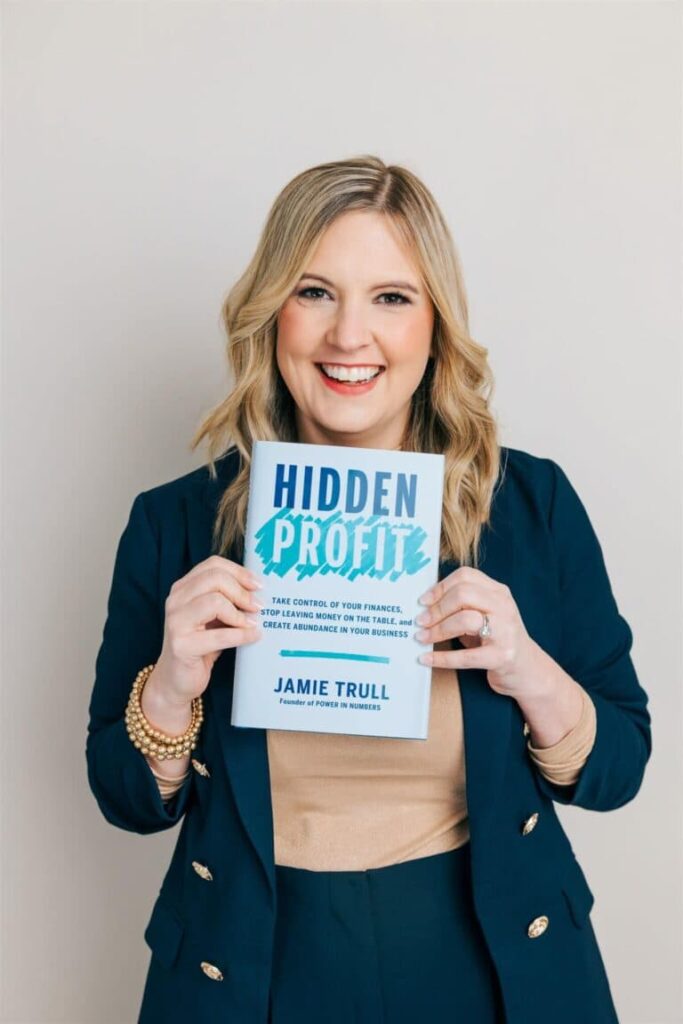
Order Hidden Profit by Jamie Trull (+ $300+ in Bonuses)
The masterclass is the spark. The book is the system.
When you pre-order Hidden Profit, you’ll get practical tools designed to help you apply everything we covered:
Your Pre-Order Bonuses (for a limited time)
- 🧩 Companion Workbook (PDF): Chapter-by-chapter prompts and worksheets to turn insights into actions.
- 🧭 Profit Lever Diagnostic Tool: Quickly identify which lever to pull next in your business.
- 🗓️ Ticket to the 90-Minute CFO Year-End Reset Workshop: Plan your best year ever with Jamie—live and actionable.
- 🎁 Additional surprises to support your implementation.
👉 Claim your copy of Hidden Profit and bonuses
(Already pre-ordered? Be sure to submit your receipt on the bonus page so we can send everything to you.)
Your Next Three Steps (Do These Today)
- Pick one profit lever to work on this week (price, ATV, direct costs, or indirect costs).
- Block 20 minutes for Money Monday and start a 10-week cash forecast.
- Pre-order Hidden Profit to lock in the companion workbook, diagnostic, and CFO workshop.
You don’t need a more complicated business. You need a clearer one—with a simple playbook you can run every week. That’s how you profit smarter—and finally see it in your bank account.
This transcript was generated from the video for your convenience, but it may contain typos or slight errors due to the transcription process. For the most accurate and complete information, we recommend watching the full YouTube video.
Masterclass Overview and Achieving Financial Stability
Hello YouTube. I'm Jamie Trull, CPA, and profit strategist, and I have something special for you today.
So if you have been watching my YouTube content, if you're a subscriber over here, I wanted to give you an extra special bonus that I normally don't do.
So typically when I do big masterclass, I don't put those replays up unless you signed up for the masterclass. That's the only way to be able to actually get access to view it.
But this time, I loved this one so much, my Profit Smarter Masterclass, that I decided to make it available for a limited time right here on YouTube.
So I know this video is long, but I really recommend that you stay until the end because there's so much gold in this, and I hope that it really inspires you and you walk away with some kind of aha moment that is gonna change your business today.
So this is a masterclass for business owners who want to make more. Not work more.
So this is all about working smarter, not harder, and using your numbers in order to do that. So I really hope that you stay until the end. We have some special things that we talk about that you want to hear about at the end of this.
And also, we're not gonna be keeping this up here very long. So this is going to be limited time that we're gonna have this available on YouTube. So if you're watching this now, make sure to watch it all the way through. Now don't assume that it's gonna be here when you come back later.
Overcoming Burnout to Improve the Corporate Profit and Loss
And the other reason I encourage you to stick around until the end is because I get a little emotional. And if you wanna know why you have to watch to the end.
I appreciate you all so much for watching my content here and subscribing to this channel.
So enjoy this bonus Encore for a limited time. This is my Profit Smarter Masterclass. I'm so pumped to have you here for the Profit Smarter Masterclass. So this is a masterclass we're gonna be talking about.
Um, how to make more but not work more, which I think is really the goal for all of us, right? I think that's really what we all want at the end of the day. Um, so I applaud you for taking the time to spend with me here this morning, and sorry for the slight delay and getting started. So we got it going now, and we're ready to rock and roll.
So I'm gonna go ahead and get started. Um, today we're gonna talk about how you can go from feeling, you know, as if you're really burning yourself out. You're just not making as much money as you'd like to make, um, to finding more freedom.
That's really the goal. Freedom is the word that I hear all the time for business owners that they're really looking for. It's not, you know, bajillions of dollars, it's freedom, right? It's freedom to do the things that we wanna do, to live the life that we wanna live.
Freedom from worry.
That's a big driver for me, is that freedom from worry. So that's what we're gonna talk about here today, and some actionable, actionable strategies to get there.
Shifting the Strategy from Corporate to Small Business Profit Margin
All right. So if you don't know me, most of you, I know so many of you in the chat, so if you don't know me, hi, I figure I'll go ahead and introduce myself. I'm Jamie Trull. I am a CPA.
I don't like to claim that first and foremost though, because then everybody asks me all their tax questions. But, uh, what I really love is, is financial strategy. So that's what we're gonna talk about here today, which taxes is one of those strategies, but it's just one piece.
Um, I do have my bachelor's in analytical finance. Super fun, uh, basically over analyzing and my master's in accounting. I am generally just a huge numbers nerd.
I worked in corporate for a long time, um, for the Coca-Cola system, so I've probably heard of Coca-Cola. Uh, I worked for them in finance for about a decade, and then I started my own CFO company really.
Working with small business owners to be the chief financial, uh, officer for their business.
And then found a love of teaching. And so that's why I'm here. I love to teach. Education is now what I do.
I like smaller business owners. I like to work with them.
And so that's really the main reason I pivoted my business back in 2019 is because I wanted to serve business owners that maybe weren't in a place where they could hire.
Or wouldn't make financial sense for them to hire A CFO, but they still needed the help and the education to get them to that place.
So that's what I do now. Um, and now I'm a financial literacy coach and a profit strategist for small business owners specifically.
Why Winging It Hurts Your Long-Term Profit and Loss Statement
So business finances are my thing. It's what I love to talk about, and it's what we're gonna talk about here today. So a couple reasons you might be here.
I'll go through these kind of quick. There's a lot of different reasons you might be here.
Maybe you're just here to support me, in which case thank you. Um, but if you are here, there's probably, it, it probably falls into one of these main reasons you love what you do, but you're tired of hustling all year.
I hear this one all the time where it's like, Hey, I started my business 'cause I love it, but now I just feel like it's, it's draining all of my energy and all of my time and I don't wanna feel like that about my business anymore.
Um, or maybe it's RAI number two. You feel like you're kind of winging it. A lot of people tell me. They just feel like they're maybe missing something.
They don't know what they don't know. When it comes to finances and you wanna be a little bit more strategic and intentional, um, again, that's why you're here.
It's a great reason to be here. Um, or maybe you just are ready. You're like, you know what? I'm tired of feeling overworked. And underpaid in my business.
And I want to feel like I am making the money that I deserve for the amount of work and effort that I put into this. So gimme in the chat. 'cause this is just a good kind of way for me to see how y'all are feeling today.
Um, what number one, number two, number three, which of these resonates the most with you, would you say? Or maybe none of them?
You feel free to write your own if there's another, another reason, and again, here I go with the chat being, uh, slightly delayed.
Putting on Your CFO Hat to Run Projections Regularly
So I'll give you just a second. But these are some of the more common things that I see. Katie says one, two, and three. Allison says two.
Yeah.
So these are some of the more common things. Lots of twos, all three. Nikki says number three. Sonya says number two. Okay, great. So two is really, um, you know, a great place if, if, if you're here because you're trying to be more strategic.
Y'all, I got strategy at the wazoo. It's my favorite thing to talk about. Y'all are my favorite people because we are gonna get strategic here today.
And one of my goals is to show you that it's not as hard as you think it is. Um, and I'm glad that you're here because if you're here, that means you understand that the idea of working on your business is important.
And so often one of the biggest mistakes we can make in business is to get sucked into our business, such that we can't ever take that step back.
So I want you to spend this next hour or so, maybe hour and a little bit, kind of taking that step back to say like, okay, I'm gonna take this bigger picture of my business.
I'm gonna get out of the the weeds and I'm gonna work on my business.
This is where I'm gonna put on my CFO hat. For those of you who have been in some of my programs, you maybe know about our CFO hat. Um, which I do have by the way, in case you're curious. This is my actual CFO hat. Let's put on our CFO hats.
I'm not gonna do it 'cause it's gonna wreck my hair, but. I love to put on my actual CFO hat. And that just basically means we're gonna focus on our finances, we're gonna focus on the big picture.
Small Tweaks That Drive a Strong Profit Forecast
And that I hope that you walk away with at least one kind of decision you make today, or aha moment that you have during this that allows you to change or tweak something in your business, right?
So I, I want this to be really actionable and I want you to come away saying like, oh, I had this idea while sitting here. Right? Maybe not all of these strategies are right for you, but maybe one is, and you're gonna walk away with that one that is, and it could make a huge difference.
And I'm gonna show you actual math for how it can make a huge difference. So yes, we're doing a little bit of math today, y'all, just to warn you, I hope you've had your coffee.
If not, go run and grab it while I go through this slide. Um, so where we're going, we're gonna talk about what a profit lever is.
What is a profit lever?
What exactly do I mean when I talk about profit levers? 'cause that's what this presentation is really about. Different profit levers you can utilize in your business to be more strategic.
The easy formula for profit. Again, we're gonna use the math, but it's easy math, I promise. It's like math.
My 11-year-old could absolutely do. Um, although maybe I'll say my 8-year-old, 'cause my 11 year old's kind of a math genius.
I'll be honest. It's math. My 8-year-old could do, my 11-year-old can do math I can't do, so I gotta, I gotta give that caveat. Um, and then we're gonna talk about the five core strategies.
A lot of talk about strategies today to find hidden money in your business. How small tweaks can equal big returns.
How Business Profit Can Actually Fuel Purpose and Positive Change
This is not about having to make these huge, massive overhauls. You can, you absolutely can, but you don't have to, right? It doesn't have to be overwhelming.
Small tweaks.
We're gonna show you in real math, in real numbers how that can add up and make a huge difference. So hopefully that gets you motivated where it doesn't have to be reinventing the world wheel.
We're talking about coming out of here and changing up your whole entire business.
It's a few little things that can add up and use the power of, you know, compounding and the power of numbers and math to help you get, get on the side of math because it, it can absolutely help you make more money.
Um, and then we're gonna talk about how profit can actually fuel positive, uh, change, purpose and profit do not have to be opposites of one another, right? I think sometimes we see them as somewhat opposing, like, which is more important?
They're both important.
Profit helps you realize the purpose of your business and the purpose of your life. It allows you to hire people, right?
Profit can make a sustainable business that can change the lives of many. If you don't run a profitable, profitable business, you're probably not gonna stay around for very long. And then how are you gonna actually achieve your real purpose?
So I get on my soapbox a little bit about this, but we'll talk about how you can be part of that movement as well. Um, and then we're gonna do a live q and a, because I love to do a live q and a.
So if you wanna stick around and ask some questions, if you're here live, definitely make sure to check out, um, the live q and a at the end.
Defining the Mechanics of a Profit Lever Control Room
Okey. So what is a profit lever you may be asking? So, that's a great question.
A profit lever, it's basically just a different way of saying strategies that are specifically aimed at increasing the overall profitability of a business.
Okay.
So we're gonna talk about what these are exactly, but just know that we're really just, it's a fancy word for a strategy to increase your profit. And this has become my new mantra, like the, the whole idea of working smarter, not harder.
Um, that is where data and numbers can come in. And these math formulas allow you to tweak things and then allow that to work for you. Allow the money to work for you, allow the math to work for you, right?
We are so used to hustling for what we make, but what if we could tap into these strategies that would allow us to actually work smarter, not harder. We're hard workers already.
Y'all, like, we're never gonna be sitting around entrepreneurs. We're never just gonna be like sitting around eating bon bonds on the couch. I don't even know what a bon bon is, but it reminds me of any married with children fans.
Like that's like the image that I have in my head is Peg Bundy with her bon bonds on the couch. That ain't us, like it's never gonna be us, but we don't have to kill ourselves, right?
For our results. We can use the power of numbers and math and profit levers to work smarter, not harder. This is like the name of my game these days, so.
I want you to actually picture, and this is why I put a picture in here of actual levers, right?
Understanding What You Can Control vs. Macroeconomic Customer Behavior
These are actual levers that are like on a wall. You're in a control room. You are in control. That's part of what I like about the imagery of a lever, right?
You are in control as the business owner. It's not just like things happening to you, right?
Sometimes it feels like, sure, there are things we're reacting to economically and you know, in, in our businesses, right? Um, but we have a lot more control than we like to, not necessarily that we like to think, but then we often think, right?
We often think that, you know, we're just at kind of the mercy of our client base or the economy or whatever, when really we are in control. We're standing in that we have the ability to react to those things, right?
And pulling these levers can be a way to react to counteract some of the, the, the things that may be going on that we can't control. There's a lot that we can control in a business.
Okay, so if we pull a specific lever, a specific strategy, it helps to remind us and give us the imagery that we are in control, right?
We are in control. You are in control, and you can make decisions that are best for your business.
Um, and like I said, profit is a very simple math formula. It's not a hard one, right? I
t's an easy, like we're talking, you know, addition, subtraction, multiplication, division. We're, we're not talking anything further than that, right? Like, that's it.
It's simple math formula. And each component of that formula essentially is a profit lever or is related to a profit lever.
Why Accountants Love to Complicate Cash Flow Statements
So that's really when we break it all down, that's what we're talking about is how do we adjust this little part of the formula such that it changes the math and it helps work for us, right?
All of a sudden we're getting compound results for little things that we're doing in the math. That's why I love math, y'all.
Even if you don't, this, these are, these are, you might by the end of this, okay, so when I talk about the formula, right, I talk about it's an easy, it's an easy, simple math formula. Here's the, at its most basic, at its most basic. Here's the formula, okay?
This is easy. Revenue minus expenses equals profitable profit available to pay yourself. One thing, some of you are gonna be like, um, Jamie, if I have any accountants here, lemme know if I have accountants here. 'cause I'm sure I do. I usually do.
You're probably like, that isn't exactly right. I know. I, sorry, I, I don't know why I did that as an accountant voice, I am an accountant, I love y'all. Right? I know because we, accountants love to make things more complicated than they really need to be.
So when I'm talking about profit, in this case, I'm talking about the money available for you to pay yourself as a business owner, which may or may not match the actual profit showing on your tax return.
We're not talking about that right now. Okay. And the reason that we're not talking about that right now is because that number on your tax return has a lot of accounting, funny business in it, right?
The Difference Between Compliance and a Strategic Sales Forecast
Like we just love to take something simple and be like, how can we make this more annoyingly complicated?
Okay, now, I didn't make the rules that the accounting rules are what they are. The IRS, whatever. But at the end of the day, revenue minus expenses, or even to simplify that, more money coming into your business, minus money going out equals profitability available to pay yourself.
If that's different from what's on your financial statements, it's because we, accountants love to make it difficult. We add things like depreciation in, right?
Which we're like, what is going on there? Bri's here. And she says, perfect impression, right? Like, I don't know. I guess that's the accounting voice. We're both accountants, so we can say that.
Um, but, but ultimately, like we ignore the accounting funny business for now, when you are being your own CFO, like that's an, that's your accountant's job, not your CFO's. And, and that there's a difference.
Your accountant's handling compliance, your accountant is doing your taxes, right? Maybe they're doing some strategy as well. But, but you know, when you're being your own CFO, you're looking at the bigger picture.
You're look, you're, you are looking at this, how much money came in, how much money went out, right? Um, Leslie says, A nerdy voice should always be used for us accountants. I don't know. It just like instinctively came to me. I'm not sure why.
Why Cutting Every Cost Can Damage Your Profit and Loss Projections
Um, okay, so profit, like, let's just, if we're looking at this formula now, it becomes pretty, like if, if I said, how do you increase your profit? Well, we bring in more money. IE increase our revenue, or we spend less, IE decrease our expenses. What if I was like, okay, that's it, guys.
Have a good day. That's the presentation. We're done now. Hope you enjoyed it.
Just do these, bring in more money and spend less.
Alright, the end, no, it's not the end of the presentation, but, but, um, it is, it does kind of boil down to this, but it can, there's more components to it that we're gonna talk about it.
Um, and, and really it's about bringing in more, okay, how do we bring in more but not hustle for it, right? And how do we spend less but not shoot ourselves in the foot?
I am very much, if you follow me at all, I am not a, you know, cut all of your costs type of person. That can absolutely be counterintuitive. This is not like personal budgeting, right?
It's not like personal budgeting where you're like, okay, I need to get my budget down as low as I possibly can't. In business, the money that we're spending can become a return that grows our business. You don't wanna cut things that are actually growing your business, right? So how do we do that the right way? How do we know? So that's some of the things we're gonna talk about here today.
Breaking Down Revenue into a Projected Profit Loss Formula
Okay. The formula profit equals, okay, so now we're gonna break it down a little bit more than what we had before than just that revenue minus expenses.
Let's take that formula and break it down even more. And it's still a very easy formula, okay?
So just take a minute, take it in. It's just the number of sales you made, times the base price that was paid, plus any add-ons, minus expenses. So we just took that same thing basically like that first part, um, of this equation is your revenue, right?
And then just minus expenses. So we're just breaking down what revenue is. Now in, if we go even farther, you could do this for each and every type of sale you make. Right? Right.
Now we're just gonna, let's go with this. Like we make, we make one thing and we sell one thing. Um, but ultimately this, this same equation applies to all the different things that you make. So.
This is what we're gonna break down, and we're gonna use this as an example throughout this entire presentation. Um, and I'll keep bringing it up. And the reason for that is these are examples of profit levers, right? So here's how I want you to think of a profit lever. I
t's just a, it's, it's it's component of the equation. So when we tweak, when we pull a profit lever, right, it's tweaking a component of the equation. So number of sales, that's volume, that's profit lever one, we'll talk about that.
The Five Core Strategies and an Upcoming Profit and Loss Forecast
Um, then we've got our order of [financial] operations. If y'all, let's remember what a parentheses means. It means we gotta add those together before we multiply, right?
So we're taking our base price, which is gonna be what I talk about in our price, profit lever two. Um, and then add-ons, which is average transaction value. Okay?
So the in add-ons are basically increasing our average transaction value. That's profit lever three. And then we're gonna subtract expenses. We have both direct and indirect. We'll talk about how those differ here in a little bit, but that's profit lever four and five.
Okay, so we're only gonna talk about five of them here today. Um, I do have a new book. I, I will be talking about this at the end. I'm just gonna warn y'all, I will be talking about this at the end. I'm really excited for this book. It is being published soon. Um, this is just my early reader copy, but, uh, in that book I actually have eight different profit levers.
I don't have time to talk about all eight here today. Um, so I'm gonna talk about five and I'm really only gonna be scratching the surface on those five. I go a lot deeper into strategies in the book, just letting you know.
But this is kind of a good intro to the types of things that I talk about in this book. And Becky says, congratulations. Thank you. Jennifer says, PDOs. Yes. Order of operations. Oh my gosh, y'all are my people.
Transitioning into the Core Five Profit Levers
Okay, so here are the five profit levers. I already kind of introduced these, but this is what we're going to, um, be talking about today. And these are the various different profit levers. So, um, volume, price, average transaction value, direct costs, and direct costs. But how do those fit into the equation? I kind of already showed you, but just to show you another way, because it's fun. Here we are. Okay? Volume, time, price plus average transaction value. And again, in this, in this scenario, average transaction value is those add-ons, right? So your total average transaction value is technically your price plus the add-ons.
But we're talking about this, um, just, I want you to kind of visually see it this way, minus direct costs, minus indirect costs, equals profit.
Notice, we're not talking about accounting funny business here. This is like we're, we are coming back to the basics of the foundations of business. And this is what you want to be profitable, right?
On paper, it can look however it looks, but this is what I want. This means you're gonna have money actually coming in that is available to pay yourself, right? If this is a positive number, at the end of the day, that's the money that you can pay yourself with.
So let's talk through these profit levers. Um, and you'll see in the corner my little starlings. You'll know if you get this book and read it, um, by the end of it, you'll know why, what the significance is of those. But, um, we'll talk about that later. Okay. So here's the volume lever. All right? This is the selling more. It's the more level lever. This is what I call it.
Avoid the Hustle Trap to Achieve Financial Stability
The more lever. More, more, more, more, more, more, more, more, right? It's, it's selling to new customers. It's just, it's, it's really hustle. Okay? This is, this is the hustle lever.
This is like the go, go, go sell more. Um, so I'm not saying that this is bad, and, and if you're in like early stages of business, this is probably where you need to be living for a little while. You need to sell some in order to be able to manage your finances, right?
Like in the beginning of business, it is a little bit of hustle. We know that like, that's just, and it's a lot of trial and error. Um, and so volume is really, really key. Then sometimes we overfocus on this to a fault, right? We absolutely overfocus and spend our time really, um, just thinking that, that these solve to our problems is just selling more. That that's just what we think.
And so that's why we chase after, you know, marketing programs and all kinds of things. 'cause we're like, we just need to sell more. But that's only one part of this whole equation. It's one, it's one part of it, it's an important part, but it's just one. And there's a trap. There's an absolute trap that people fall into. You cannot fix a profitability problem by selling more. If your problem is your underlying profitability, selling more is not gonna help. It's just gonna burn you out. Okay? It's, it's a pan, it, it's a, it's a recipe for burnout. Maybe you'll make a little more, but not substantially. And we have to fix that underlying profitability problem first. Okay. So let's consider, and we're gonna walk through this, right?
Benchmarking the Baseline Profit and Loss Statement
This is what the rest of the profit levers are gonna talk about. How can you optimize your profitability before chasing after more sales, right?
So if we do, if we optimize our profitability and then go back and make more sales, all of the sudden, every single extra sale we make makes us exponentially more money.
Again, this is just where it comes down to the math equation, right? So I am a proponent of selling more, right? But only if you know that every single one of those sales is going to be sufficiently profitable, right?
Anything less than that, and you're just, you're gonna burn out. You're just going to, um, okay, let's come back to the numbers because we're gonna keep coming back to this, and that's why I want you to stay to the end. Don't, don't jump off early because you need to see.
The full, how This kind of goes through the entire gamut of all of these different profit levers.
So this is our example. We're gonna use an example. I kind of amalgamated multiple different examples from businesses that I've seen and worked with and talked to. But I thought a good one would be, um, a product based business. So let's say you're an online shop, you sell custom tumblers, right? You're purchasing them, um, probably in bulk, and then you are, uh, customizing them, selling them on Etsy, Shopify, your own website, whatever. It's. Here are some of these, um, these are just important kind of baselines for where you are right now. So starting, here's our starting, here's what we're gonna benchmark against. We're making 500 sales per month because we are killing it at the, at the online, uh, Tumblr sales business. Like we are murdering it.
Product Pricing Framework and the Initial Sales Forecast
We're making 500 sales a month. Average sales, $50. Stick with me. Try not to be like, oh, would anybody pay that? Like, don't take, this is an example, so don't overanalyze, right? We're gonna assume you, you sell one thing, you probably sell multiple things, but for the sake of the example, and to simplify the math, we sell one thing, sell $500 of them a month.
The average base price is $50, the average add-on. So, um, customization, we on average make another $5 in total from each sale, and, uh, sometimes more, sometimes less. So that average is out to the $5. Our cost of goods sold are direct costs.
Essentially, the cost of the, the product is, uh, 60% of revenue. So often you'll see this quoted as a percentage of revenue. We'll talk about direct costs and how they move with revenue here in a little bit, but that's just important to know. We don't have a dollar amount for this because if we sell more. Obviously cost of goods, solds gonna go up.
If we sell less cost of goods, solds gonna go down. So we're gonna look at it as a percentage of revenue and an indirect cost. We don't look at as a percentage of revenue. 'cause those don't move exactly with revenue in the same way.
They might indirectly move with revenue. Like if you sell a heck a lot more, maybe they're gonna be more indirect costs, but it's not like a one for one. Like each sale increases your indirect costs.
So this could be software marketing, um, and admin assistant. In this case, that's what, uh, her indirect costs are.
These are often called overhead. Um, so that's what we're talking about here. So this is the example. So just we're, I'm, I'm just giving this to baseline, this. I'm gonna show you where this person is at right now.
Calculating an Underwhelming 7% Profit Margin
Let's call her, what should we call her? Um, I'm gonna look for a name. Okay. Becky. I saw Becky in the comment. So Becky is selling custom tumblers. Okay. Becky's like, what did I do? Why are you calling me out? Okay. Uh, so let's plug it into the formula.
Right. So 500, she sells 500 at $50 each. And then there's an add-on of $5. So 500 times $55. Feel free to check my math y'all. $27,500 a month is her revenue.
Not bad.
She's making over like 300 k in revenue from this business right Now. Those of you who are product-based businesses, you know, right?
You know that, um, that, that looks like a lot, but because so much of that is going to your cost of sales, you're only making a fraction of that. So let's see how much Becky is actually making at the end of the day. So her revenue's 27,500. Her direct costs are 60% of revenue.
That's 16,500. Her overhead, uh, indirect costs are $9,000 a month. So her total profit per month is only $2,000, right? That's a 7% profit margin. That's not great.
That means 7 cents on every dollar she makes is what's actually available for her to pay herself.
Okay.
Um, and none of these numbers yet include her pay, so that is fully what's available for her to pay herself. So that's $24,000 a year that she could pay herself.
Even though she's bringing in over $300,000 in revenue, we gotta fix this problem, right? She could sell more. She could, let's see what happens if she just sells more?
Okay?
That's one way, and this is typically what you would see. What what Becky would do first typically is probably what most people would do. First, let's figure out how to sell more, right?
The Incremental Gains of Scaling Volume Alone
So in this case, let's say she sells more, she sells another 50. So she's really busting, she's hitting the pavement. Um, she's probably increasing her costs as well. Her indirect costs as well through marketing or, or whatever she's doing.
We're not, we're gonna ignore that for now and pretend like her costs are gonna stay stable, but in reality it's probably costing her more to sell more. So this is probably a, uh, a little bit of a rosy picture, but, um, she is selling 50 more, but everything else stays the same.
What does that mean Now her revenue's 30,000, two 50 a month. That's pretty good. 10% increase in revenue. Makes sense. 'cause she increased her sales by 10%. That means an increase in revenue by 10%.
But then we come here and we work it out. And if she's still at that 60% of revenue for her cost. Right, because she hasn't changed anything related to her, her profit or anything like that.
Um, her costs have not now gone up. So that's going to eat into some of it. And we're just gonna assume for simplicity that her indirect costs stayed the same.
They probably didn't, they probably went up, um, to, to help her get those extra, uh, ex um, sales. But let's just assume, let's make it easy and assume that they didn't.
So her total profit's now $31 per month.
She's now gone up from a 7% profit margin to a 10% profit margin. Okay? So stick with me. Um, that's a 3% profit margin increase. That's not bad. That means, you know, we can continue to chase that for a long time.
These little incremental, like, okay, I got 3% more, but I want y'all to do a heck of a lot better than a 3% increase in profit margins.
Transitioning into Pricing and Strategic Projections Regularly
Okay? I, I just, we can do a lot better than that and I'm gonna show you how to do that with the rest of these examples. Um, so like I said, we're gonna maximize our impact by focusing on the sales volume.
After pulling other profit levers, making sure that we are sufficiently profitable, and then selling more of that more profitable thing, right? Okay. So how, let's talk about Lever two price. All right, so this is, this is one.
We love it or we hate it, but it is a conversation we gotta have around pricing and it's really about determining the right amount to charge for your products or services.
I say, right, but know that there is not a right, and sometimes we think that there is. So that's really kind of a misnomer, right? It's us determining the right at this moment, not the right exact right amount to charge.
It's kind of us as a business owner testing things out and seeing, okay, what's what's gonna sell, right? But is also something sustainable. This is about coming up with what are we actually going to charge people for the services we provide or the products that we provide.
Okay? Increasing your price can make sense and you see a lot of like increase your price, double your prices and then, you know, charge your worth and then add tax. Like all these, you know, this was, I feel like this was all the rage at one point.
That was just like everybody doubled their price.
We were in economically like really good times. Then you, you could right?
You maybe could. Um, but it depends on the type of business you're in. That may not always work for you to like, just, you know, across the board, double your prices.
Balancing Higher Prices Against Macroeconomic Customer Behavior
If you're a coach or a consultant and you have, you know, maybe, but a lot of you know, true small businesses, that's not really possible. You wouldn't sell anything if you doubled your price. You have to value it with, you have to balance it with volume.
Realistically, more than likely, not always, not always important to know, but more than likely, if you increase your price, your sales may fall. The question is, how does that equation work? Right? Do you still make more money making less sales? Great.
That's the dream, right? So it's really about figuring out, okay, where is that right place where I'm actually, you know, maximizing the amount of revenue that I can make at that price point, right?
Price times volume equals, you know, what you wanna be focusing on.
If your volume is changing, when you increase your price, kind of working out that math to figure out, okay, where does that make sense?
Because sometimes it's okay to lose some people based on price, especially if you're still making more money at the end of the day. Uh, okay, so let's talk about pricing do's and don'ts.
I'm gonna, you know, go through these kind of fast, um, but I think they really are important.
And again, hopefully, you know, hopefully you walk away with some ahas, some things you might want to try after this webinar today.
So don't for pricing, don't undercut your pricing just because you wanna lower expectations. This is a recipe for failure. A lot of people are afraid to charge more because they are, um. Really, really worried that that increases expectation in the minds of people who are buying, right?
And if I charge a little amount, then I won't have to worry about my own insecurities about whether this is worth the price or not.
Moving Beyond Competitors to Build Better Profit and Loss Projections
And so we keep prices low and think that like, okay, well then I won't have to deal with people being disappointed. Like there's a lot in there, like that's like, we need to talk to a therapist on that one. But that's very common.
It's very, very common to feel that way. Don't do that. Don't do that. 'cause we also know, like honestly, most of us have been around long enough in business to know lower prices don't mean less people complaining.
In fact, sometimes it can be the opposite. So this is not gonna protect you from people being unhappy, right? Like it just isn't, you don't want to do that thinking like, oh, this is gonna be easier. Um, you know, if I can lower these expectations.
Don't price solely based on your competition or your gut. Yes, yes, yes. I know we need to pay attention to competition.
Some of you are in, um, you know, very flooded fields where there's a lot of competition either locally, online, wherever you sell, but don't think that pricing, like don't pick your price based on like, oh, this is the middle of the range, or this is lower than my competitors.
You don't know what their costs are, you have no idea. And you could end up actually shooting yourself in the foot again, selling something for less than the cost to produce it if you do that.
Um, so that's really, really important that you make sure you are not over-indexing on your competition because competing on price is a losing game.
Y'all, we know this.
We instinctively know this, and y'all are small businesses. You are not Walmart. We cannot compete.
Differentiating Your Brand Value Over Cheap Market Competition
If you're selling the same exact thing that they sell at Walmart, they're gonna be able to sell it for. Less than half the cost probably of, of yours, maybe even significantly less than that. So what we really need to do is differentiate, right? That is the key.
We can't be pricing based on competitors. We need to be differentiating ourselves from competitors to be able to justify charging a price that is sustainable for us and profitable for us.
And I don't mean to say, like when I say, you know, charging based on your gut, right?
Um, I don't mean ignore your gut.
Your gut is important, but sometimes things we confuse for our gut is really like our insecurities getting in there or whatever it is.
There's a lot that can kind of muddy the water.
And that's why going back to the math and at least having that as a data point for you, what's the math to be profitable is really important.
We don't wanna just be led by, you know, kind of these things. Um. Let's see. Tony said, if your price is too low, it will seem as cheap and has no value to your customers.
Yes, this is so, so true as well, where sometimes you can actually make, like I, I have seen people raise prices and make more sales. Not kidding you, which sounds counterintuitive, right?
But again, it's positioning. It's positioning and it's it's positioning to the ideal customer that you're trying to attract. Um, and don't change your prices without considering that volume impact, right?
Sometimes it won't have any impact at all. Um, again, sometimes again, it could help your perceived value and maybe you might make more sales more. Most of the time it, you will see a dip in sales the higher priced you are.
Incorporating the Real Value of Your Time into the Equation
But you might be getting better quality sales. They might be more your target market. And it also, again, at the end of the day, if you're making more money. Then, you know, then who cares if you're making less sales?
Right? Um, so yeah, we have to have, you know, Brian says yes. It's called perceived value. Exactly. Exactly. Perceived value is really important and we have to work. That's the marketing side of things to make sure that people are perceiving the value that's really there.
So here's a couple of pricing dues. Know your profit margins on a product or service basis, including your time. I will soapbox on this until the end of time, I don't have enough time to go super deep into it. I go really deep into this specifically about even how to value your time. 'cause a lot of people, that's a struggle.
How, if you're a service-based business, how, what is the value of your time? Me, and I'm not talking about S Corp reasonable salary here. Like that's again, an accounting convention. I'm talking about what is the actual value of your time.
And we need to make sure that we're including that when we're putting prices on things. Because if we don't, you won't ever be able to hire someone. Okay?
So you need to know the cost to produce the product or deliver the service, um, and then add a markup. Okay? So know the cost and then add a markup. And the reason we have to do that is the cost for a service-based business.
You're like, well, the cost is just my time. And I don't know, think about if you were to hire an employee to do this, even if you wouldn't do that.
Pricing Your Business Infrastructure to Hire Future Help
But if you were to hire an employee to do the work in the business, not as a business owner, not all that work, but the work servicing customers, right?
What would you have to pay them? That is the cost.
And then you need to add a markup. So that markup then pays you as the business owner and the expenses of the business, right?
So, so often we say we can't hire like, oh, I can't hire anybody to help me.
That's because your pricing doesn't allow if you, if you can't hire someone to help me, because you'd be paying them more money than you're making, go get a job.
And I say that with love, but like you would make more money working for someone else and you wouldn't have to pay overhead for your business and you wouldn't have to worry about marketing and you wouldn't have to deal with the risk of it.
You should be compensated as the business owner for those things.
So you need to be paying yourself as an employee of your business if you're the one doing the work. And as a business owner for the one taking on the risk and doing the work of the CEO and CFO, that means that has to be baked into your prices.
And that should be baked into your prices even early on. Right?
Because it can be hard to raise our prices if we have charged so low for so long and then we're like, man, I wanna, I wanna hire someone, but I can't afford to pay them. Right.
That's gonna be hard. And, and then it's gonna be hard on your customers to kind of switch them and say, okay, now we're having to increase prices a lot.
Start early, start early, building in room that if you needed to hire someone to step outside of the business, you could.
Overcoming Mindset Blocks to Elevate a Product Price Profit Forecast
And that is in pricing. Don't wait until you're ready to hire. And now coming into this, having this, you know, exact problem arise, go ahead and price it in.
And then when it's time to hire someone, when, when you run outta capacity, you'll be able to do it and still be making money. Important. Okay. Um, consider where might I need to adjust my prices?
I want you to think about this for a second. Where could you potentially adjust prices in your business? Is there something that comes up that, um, you know, you can think about?
This is it, there might be something already that came up as we were talking about this, that, you know, oftentimes we know, we know if we're underpriced on something, we know it, it's there.
You know, we just don't wanna do the work to then like, have to deal with, okay, now I have to get my mindset shifted and, and now I'm afraid of what my customers are gonna think and all of this stuff.
But the first thing is I just want you to decide, yes, I need to make this change.
And once you make that decision. Then figure out what are the steps you're gonna take? Are you gonna first roll it out to new customers? That can be an easy way to do it rather than, you know, make sure to test it out.
See if people will still buy it at that higher price.
Addressing Inflation Gaps to Adjust Your Projections Regularly
You don't have to do it all at once.
You can, some people choose to, but just think about if you need to adjust your prices. We've had, you know, periods of inflation. Some small businesses have not like adjusted their prices. Prices in years.
The cost of things has gone up, the cost of labor has gone up. The cost of products have gone, gone up, right? Everything has gone up.
If you have not adjusted your prices in years, I want you to do it today. I want you to do it today. Something, something. Adjust it in some way today. Make that decision. Okay? So let's go back to our formula. I'm gonna keep coming back here, so just stick with me.
So before we were talking about volume. So we added 50 sales, but what if we had added those 50 sales after also increasing our base? Right.
What if we increased our base price and then added those 50 sales?
What if that base price went up by 10%? We did the math, we decided that that's the best thing to do is add 10%, we noticed we didn't double our prices.
And we didn't say, okay, now those $50 tumbl are a hundred dollars.
We said they're $55. Okay?
And right now the add-ons are the same. We'll get to that in the next profit lever. That brings total revenue to $33,000. And now we've increased, uh, by 20%, which again makes sense.
We added 10% sales, 10% to our best price. That's a 20% revenue increase. Okay, so I'm not gonna go through the rest of this.
We'll, we'll, I'll show you how this all adds up, you know, as we get to the end.
So that's great. We're getting there. We're getting there, but I wanna go higher.
Aligning Upsells to Match Average Transaction Value
Okay. Lever three, average transaction value. Okay, so this is kind of a component again, of price.
Price is a component, I guess, of average transaction value.
But so are add-ons and these small add-ons to existing sales can add up and they can add up a lot. Um, and it may just be a small amount to each individual customer, but to us, receiving all of that can make a huge difference.
So average transaction value, that's a TV. Here's some dues related to that.
Add something that compliments what they're already buying, right? Like if there's, if, if they're buying something and there's something that goes along with that amazing, offer it, right?
There's probably a million things that could help compliment what they're already buying. It gives you in, you have insights into the things that they want.
What else could that same person that wants this thing A, what's a thing B, that they could also want? Right? Think about that. And not everyone needs to upgrade. We don't have to. It's not like we're not trying to get a hundred percent of people to upgrade.
We're trying to get a percentage of people that are most interested in it to upgrade, and then that's more profit for you. It does not need to be every single person. Okay? And then you wanna demonstrate the value of it to make it a no brainer.
We wanna make sure that we are doing that work to market it well. Such that it's like, oh, okay, yeah, that's great.
I'm gonna add that too. Here's some don'ts. 'cause some of you are like, oh God, upsells add-ons. Like, I have no interest in them. And that's because your experience with them in some cases may have been people doing it the wrong way.
Airline Industry Pitfalls and Misaligned Profit Margin Fees
So I don't want you to do it the wrong way. Don't upsell something that isn't aligned with the original thing they're buying. 'cause it's not gonna make any sense, right?
We need to, it needs to make some sense. You know what I mean? So that's, that's really, really key.
A grocery store is like, okay, you're in here, you're buying food, you're buying different things. Uh, here's some magazines and some gum. Let's see what, well, they're not selling shoes, right?
They're not like, there's not like an aisle of shoes right before you check out. 'cause that doesn't make any sense, right?
So make sure that it's something that is aligned with the things they're already purchasing. Then, um, make sure that the add-on isn't something that they need in order to get full value of the thing they already purchased.
And this is a mistake I see a lot of people make, and I wanna talk to the airline industry here for a minute because those airlines that make that charge you for a carry-on bag.
Qho is getting on a flight without a carry on or, or a checked bag who's getting on a flight with no baggage?
It's ridiculous that you would pay for a flight and then have to also pay to bring a purse.
Like that is just insane to me. So that's where it annoys people, right? And it can be unexpected. And you're like, well, in order for me to get the value of this flight, I now have to upgrade. I'm at the airport, I have a bag.
You know, maybe I did or didn't know. Um, and now I have to pay to just bring this bag on. I can't get full value of what I paid for without it. Don't do that. It's gonna annoy people. It's gonna drive them insane.
And similarly, right? Similarly, my airline industries do this too.
Don't annoy people with endless upsells or surprise fees. Tony says, don't get me started on the airlines right now. Yeah. Tell me, give me, uh, this'll be fun in the chat. Tell me any industry that does this the wrong way or, or specific company. Y
ou can call 'em out. It's fine. Um, because we've all experienced this, this has been annoying to all of us.
Balancing True Value Against Endless Add-On Upsells
And this is also why number two is also why I recommend, like where you can include shipping right. In your purchases and not have an add-on for shipping.
Because that's another thing. Like, okay, so I have to pay for this and then I have to pay for shipping and I can't. Have the value of this without shipping.
So it's a little bit of a different story sometimes, but where you can bake those into the prices, I think it's, it's a better feeling to your customers to say free shipping, but maybe your cost is a little bit higher to cover it.
But it's just these endless upsells. And with the airlines, it's like, okay, now it's like to buy the seed, I want, I have to pay money or to do, you know, everything is an upsell and that's gonna drive people insane.
Um, so don't, don't be, you know, that business, don't do it the wrong way, but there are lots of right ways that you can do it that make people want to buy from you. Rebecca says, cell phones. Oh my gosh, that is so true.
My cell phone bill is insane. Jennifer says, I see this a lot with website designers.
Yeah, right? It's like, okay, you'll have your website, but uh, in order for it to actually function, here are these other add-ons you need?
And it's like, well, well shouldn't that be part of the package? Like, I don't wanna half of a, you know, it's like, it's like a photographer. It's like a photographer charging you to do a sitting and then later on being like, oh, if you actually want the photos from that, here's this.
It might be one thing where there's a certain amount included, but something should be included. No one wants to just pay to get their photos taken, right? Like, that should be included in the base price, whatever it is, a certain amount.
And if they want more, that's where the add-on comes in. But like, make sure that they, they can get full value with just the main package and then offer additional things, um, that they can use.
Incentivizing Your Team to Boost Average Transaction Value
Okay, so just the math on this, let's say 20% of people add a 20, a two, $20 upgrade to whatever you're selling, right? Um, so for example, that's a $4 increase in your average transaction value.
So that's just 20% times that $20 upgrade. You can increase that significantly. Let's say you went to 25% at a $22 upgrade. I think that's about $5 50 cents, I believe.
Um, y'all can check me on that. Increase in your average transaction value. So again, it's a factor of percentage of customers who opt for it times the price.
So either way, if you want to increase your average transaction value, you can do it by getting more customers to opt into the add-on that can be a marketing thing. You know, that's just focusing on really trying to sell it.
You know, if you have, if you have employees incentivizing them to sell these upgrades, right?
Um, or increasing the number of customers, uh, that, uh, sorry, or increasing the, uh, the amount that you're charging for that add on.
So those, it's a factor of both of those. Um, so you can kind of decide what makes sense for you, uh, to do. All right, back to our formula, average transaction value. Now we've added $50, we've added 50 sales for volume.
Um, but we did that after also increasing our base price by 10% and increasing our, our, uh, average transaction value, the add-ons by $5. Okay, so let's see what happens. Now, all of a sudden now we're at $35,750, which is a 30% revenue increase.
So we're all of the sudden now figuring out ways to make more money without hustling. Notice. This is not with any more sales than what we already talked about, and we're seeing, you know, the results come through. Um, let's see. Okay.
Bundling Smart Add-Ons Built for Your Customer Behavior
Consider, what would compliment this offer? Whatever offer you're thinking of in your head right now, whatever product or service you're selling. That my customers may also want. Write that down and think about that maybe more after this, right?
So maybe your first move here is to increase your prices. Maybe your first move is to think about like, what other things could I either bundle with this or add to this offer to existing customers, right?
That they might be interested in based on what they're already buying. And do it in the right way. Go through the do's and don't's and do it in the right way. Don't annoy them, but make them say yes, I want that. That sounds great.
Okay, lever four. We're getting close guys. Lever four, uh, direct costs. So these are the costs that are directly related to the products or services you are selling. Okay? So when I say directly related, it means things that really vary with how many sales you make.
So it's easier in a product-based business, um, that's cost of goods sold in a product-based business, right? Like I purchased something.
Either that's materials or if you purchase something wholesale to sell it, retail, whatever it is, that's your cost of goods sold. So that's kind of easy to, to think about in the service business. It could be, uh, your employee time delivering that service or making a product.
And like I mentioned before, that also means it could be your time delivering a service or making a product. Okay?
So again, think about if I was an employee and I had to hire someone to do this work, to, to deliver the service or make the product, how much would I have to pay someone to do that?
Right?
And then your costs that you're charging your customer should be higher than that. Um, so you need to kind of consider those direct costs in this.
Understanding Gross Profit Over Variable Expenses
Um, let's see, expenses that vary directly with the number of clients you have, right? So these are, this is things that kind of are on a direct relationship. A lot of our indirect costs go up indirectly as we get more customers.
But I'm talking like directly I have another customer and that adds another $3 in cost or whatever. It's right, it doesn't include your overhead. We're gonna talk about that here in a minute with your indirect costs.
So I showed you in that equation that they're typically, I'm gonna represent them as a percentage of your revenue. 'cause that's often how we think about them, right? It's ultimately a percentage of what we're charging and more sales is gonna be more direct costs. Um, and this is how you get to gross profit.
So when you're, when we're talking through like what is gross profit versus operating profit or general profit, we're just talking about direct costs when we're talking about gross profit.
Revenue, money coming in minus direct cost to produce the uh, product or to deliver the service equals gross profit.
If you're gonna try to figure out your profit margins, I talk a lot about it in my book. I have a whole chapter on profit margins that can go a lot deeper, but this is where you start for each product or service you sell.
What's the price of it, right?
Revenue you make minus the cost to produce that thing equals the gross profit. And then you can come up with your percentage there as well, what your gross profit percentage is.
So those are really key when you're evaluating things on a product or service basis. Um, so how do we reduce this?
How do we reduce our direct costs?
Well, it's a couple different ways. Product-based business, it's going to be sourcing your materials.
Bulk Sourcing Dynamics and Protecting Your Business Cash Flow
How can we save money on sourcing materials? Is that going out to bid? Looking for other providers, other, um, you know, uh, places that you may be able to source the things that you need.
Maybe it's bulk orders.
Now, with bulk orders, you need to, you know, if you get a discount for buying in bulk, that's great. You also need to kind of balance that a little bit with your cashflow needs.
So it's great if you can afford it, but you gotta make sure you can afford it. You don't put yourself in a bad spot. Um. But with product-based businesses, it's, it's about, okay, how can I do this?
How can I get, you know, not necessarily cheaper, I don't like the word cheaper, but how can I do this less costly? How can I reduce the cost of each thing? Um, and then also with service-based businesses, it's very similar.
How can I save time by streamlining tasks? How can I do this quicker? How can I be more efficient? Whether that's you or your staff. And again, that's just saving time on what you're doing. Where are processes that you can refine, right?
And that's where streamlining processes is so key for a service-based business, because y'all time is money. Time is money. It's, it's literally the same, especially when you're hiring an employee, but you need to think about it even if it's your time.
That's where we see that with an employee. 'cause we're like, okay, the I have to pay them the more they work.
But with your time, that's true as well. Your time is money as well because the time you're spending doing this work and doing things that are inefficient is time you're not spending is opportunity costs.
You're not spending on the things that would actually help you make more money, grow your business, or even just like the time to live your life, right? That has value and we need to remember that.
Auditing Packaging Costs to Improve the Projected Profit Loss
So consider how you can reduce direct costs without impacting quality. We don't wanna decline quality, and that's that for product-based businesses.
That's always the tough thing. It's like, okay, I want to do this, but I don't wanna reduce the quality of what I'm doing. So maybe it's packaging, right?
If you're in a product-based business, you don't wanna, you, you want the product to stay what it is, but maybe there's a way to save money on packaging. Right.
That could be a, a place to start where you're not having to impact what you feel is the quality of your actual product, but the things around it, and then we can kind of figure out from there.
And then service-based, again, it's about, it's not about just like, you know, doing sloppier work, right?
Spending less time, you know, uh, doing the work.
It's about making it more efficient to where you're able to give the same quality and sometimes even better quality once you have made those processes more efficient.
Um, Martha says, I love all these practical examples. I hope I, I'm, I am very practical, y'all. I'm a CPA. Like this is not pie in the sky.
These are like real strategies and I want you to just, you know, consider this.
What could you do?
Um, for this, this might, this is another one of those questions to write down, to think about after to maybe this is the profit lever you need to start with.
Maybe your costs have gotten higher and higher over time, and it's time to really get serious about reducing them. Okay, so let's say that we're going back to our formula. W
e've got our extra revenue, our revenue's gone up by a lot.
Our starting revenue, if you remember, was 27,500. We're now at 35,750 with those first three tweaks that we did to those first three profit levers, which were volume, price, and average transaction value.
Expanding Profit Margins Before Squeezing Sales Volume
Okay? Now we're gonna decrease cost of goods sold.
And instead of them being 60% percent of uh, revenue, we're gonna get them to 50% of revenue. Now, simply the act of increasing your prices is gonna do some of this work for you. By the way, simply the act of increasing your prices, right?
If your costs stay the same means that you're gonna have a lower percentage of your revenue that's going to your direct costs.
And then if you couple that with also going out and figuring out how to, how to fix efficiencies, uh, inefficiencies, and how to, um, maybe source your product for a little bit cheaper, right? Um, this is what we're talking about here.
So let's say we decline it to 50 to 10% to 50% of revenue. All of a sudden now, the cost, our profit margins are expanding, right?
Our overall profit margins are expanding and reducing direct costs will increase profit margins on each and every sale you make.
That's why it's so important to do before we start hustling for more money, right? Like more sales. We need to make sure that we're sufficiently profitable on each and every sale, because otherwise we're just working ourselves into the ground. Let's use the math to our advantage.
Let's make sure we're maximizing optimizing this first. Okay, last lever for today, y'all. Can you imagine how long I'd go if I had eight?
And this is just the very base overview. I've so much more, um, in the book on these things, indirect costs include both the ongoing and occasional overhead costs to run your business that don't directly correspond to the number of sales you have.
Plucking Low-Hanging Money Leaks from Cash Flow Statements
Okay? So these are just indirect. These are things that are, you know, uh, your overhead costs. They're. Software subscriptions, they might be administrative staff. Um, these are kind of the things that don't vary exactly with the number of sales that you make, right?
So these are honestly the other thing that can balloon really quickly. These, these are, it's very easy for these to kinda get outta control. If people are looking for quick wins, I usually tell them to start here.
If you want a quick win, go look through your expenses for the last 90 days, and I bet you can find off the top of your head some to very quickly say, oh, I haven't even used that subscription in a year, or whatever it is, right?
So your goal is to reduce expenses that don't have returns. So any of those money leaks, those are things that you're spending money, but you're not getting return on it, right?
It's just, it's just going out the door and it's not a necessary expense. So why are we doing it? Right? So let's reduce those. And then when you're sufficiently profitable after doing that, you, you should have more money to then.
Use to increase investments that you expect to provide a return.
So the short term way, right, we're gonna reduce expenses in the short term. In the long term, we're gonna use that increase in profit to reinvest back into our business for things that are actually gonna grow it.
Scaling Sustainable Visibility Through Your Money and Your Time
If, if you know me, I'm not a person who's like slash everything we need to be running on, you know, crazy lean, right? Like, no, you grow your business.
One of the ways to grow your business, a fuel for your business is spending money. There are two fuels for your business, your money and your time.
Those are the two things you can invest in your business, right? In the beginning it's mostly your time. 'cause you probably have more of that than you have money.
But once you have some money, that's when we need to be using that money to fuel our business. But it needs to be on something that's actually gonna grow our business, not just money we're spending that's out the door and that takes a lot of intentionality and paying attention to our numbers, right.
Okay. Um, let's see. Let's see. Uh, I love this. Oh my gosh, Sally. I love all the people in here.
This is so amazing. You guys are so great. Sally says, for those of you who are new here, I can't stress enough how much you shouldn't get in the weeds with these numbers.
Yes, I'm a to the penny person and I'm always getting stuck in the weeds. Take a broader look, I say all the time. It doesn't have to be perfect to be useful.
When you're your own CFO, like your accountant can get down to the penny. Great. Okay, have fun with that. That's even probably more granular than they need to be.
But for you, you need to have the bigger picture in mind. That's why I'm simplifying this down to a formula, right?
Catching Invisible Money Leaks to Protect Your Profit Margin
You need to have, um. The bigger picture in mine, it's not about cutting all expenses, it's about reducing the right expenses.
I just saw J Jackie just said, just identified seven money leaks to cancel today, y'all, we've been on this webinar for like an hour and Jackie has already probably within the last like five minutes, identified money leaks that she can cancel, which is amazing.
So that, again, if you're looking for a quick win today, just do that. When you get off of this, just spend, you know, 20 minutes looking through the last 90 days of expenses and making a list of what you, you need to cancel.
Even if you don't spend the time canceling it yet, you can do that tomorrow, but just, just do that. And I that, I love this. I love this so much. David said, when will your book be book be released? Oh, give me just a second, David. We're almost there.
Okay. That's some very blatant foreshadowing.
Okay. Uh, reducing indirect costs. What do we do? How, where do we start subscriptions? That's probably where Jackie started. I would imagine those subscriptions.
Even if they're small, you're paying for them every single month and everybody's gone subscription based these days. Like, it just, it's the thing to do.
So if there's subscriptions, maybe a free trial rolled off and you didn't even realize it, um, I'm guilty of that by the way. This is, it's a good time to go and just slash some things.
Balancing Software Subscriptions Against True Operational Value
Maybe you can pause some subscriptions if you're not sure you're using 'em. Pause 'em, see if anything goes wrong, and then restart it if it does.
Um, but that's usually a really good place to, to start are those recurring things that often we don't spend time on. 'cause we're like, oh, they're small, but again, collectively that adds up. Um, and similarly, collectively, when we cut them, that adds up.
Uh, and where are you spending your money that isn't pro providing, uh, a return? So just think about the things you're spending. If you, if that money you're spending is saving you a significant amount of time or money, then keep spending it.
Don't cut it. I don't want you to. It's gonna, it's gonna come back to bite you. I once cut my Calendly, um, and then I ended up having to like, go back and forth with people for a million years about calendar.
Uh, you know, um. Availability. And I'm like, man, I probably should have just kept that $12 a month expense. 'cause this is, this is, well, it was well worth the time I saved. Um, so I love this.
All right, consider, where could you cut, reduce expenses that aren't providing a clear return on investment. So again, this might be the profit lever you start with in direct costs.
This is the, this is the low hanging fruit. You find yourself some low hanging fruit. Cut it today. Like that will be the win. It will be time well served if you do that, like Jackie just did. Amazing. Okay. Formula, formula. Let's go back.
The Compound Effect of Optimizing Your Indirect Costs
Now we're, now we're at the end. So we get to actually see how this all comes together, y'all. So if you've been wondering, remember this person made, we're gonna go back and show you what, where they were before.
And then we're gonna show you after these tweaks.
And these are not huge tweaks, right? Let's say in this case. We're decreasing overhead by 10%. Jackie probably just did that in the last, like, or she's close in the last, you know, few minutes. So this is not hard to do. It really isn't.
You can find like start with 2% if you want to, but you can probably find 10% to cut. And if you can't, if you can't, it might be time to find some things to invest in.
'cause you might be a little bit stingy with your money and it might be time to actually go find some proactive investments to help you grow your business.
But that's a whole nother talk. Um, I will not soapbox on that right now.
So let's say you did this, right? So now we've got our extra revenue. We increased our revenue with the first three profit letter levers, and then the second two profit levers we've in, we've decreased our expenses, right?
So revenue minus expenses, rev, we put revenue was up by 30% and now we're putting expenses down. Now our total monthly profit is $9,775.
Do y'all remember what it was before? 2000? Yeah. Mm-hmm. Yeah. 27% profit margin now from 7% to 27%. Little bit better, right?
Unlocking a 389% Increase in Your Baseline Profit Forecast
So let's go back to the before. Here's where we were, just to, just to recap. We were at $2,000 before profit margin per month, uh, profit per month, 7% profit margin.
Now we're at 20 per 27%, $9,775. Y'all's 389% increase in your dollar profit. Hang on. Wait, what? We didn't do anything crazy.
None of these examples were double your prices.
All of these were small tweaks, little tiny tweaks that we did, right? Like to, to little things throughout this equation. We used the math for us, and then we went and sold more after we were, we did all this. We said, okay, now I'm gonna go sell some more.
And, and this is what we ended up with, right? Remember how just selling more, how much profit margin did that, that gave us 3% extra profit margin. Woo-hoo. All right. Like. This is better.
And a 389% increase in profit, again, it's gonna vary. Your situation's gonna vary based on, you know, your prices. You're gonna put in all your information, but this is what's possible. And so I want you to see that it doesn't have to be, it's hiding. It's hidden. It's hidden.
The profit is there, it's hiding in plain sight. And we need to just go find it. And we start by pulling each of these profit levers, right?
Pick one. It doesn't even matter which one, pick one that resonated most with you today. There's probably one of these, maybe it's pricing, right?
Maybe you wanna do some add-ons. Um, maybe it's, you know, your direct costs have gone up and you need to go through and figure out how to, how to get those down.
Overcoming Sales Overfocus to Align with Real Customer Behavior
Um, maybe, you know, your indirect costs have ballooned and you need to figure out what to cut. Right? Start somewhere. Then, you know, continue along and then all of a sudden you've optimized and it's crazy. The, the mathematical effect of that.
And that's what I just wanna prove. Math. This is why math is fun. Math is how you work smarter, not harder, right? Using your numbers is how you do that. It's not all about hustling for more sales. Goodness gracious. Okay. Uh, who wants to give me, feel free to put in here.
What are the five profit lever? I just talked about them. Uh, so I'll, I'll go ahead and put them out here. But go ahead and put in the chat. What are these five profit levers, um, that we just talked about here today? Tell me actually, which one you are going to start with. First, I wanna hear which one you're gonna start with first.
Here's what they are. Volume, price, average transaction value, indirect cost, direct cost. Which one are you gonna start with and what are you gonna do today? That's what I wanna know from you. And then I'm gonna finish up here in just a minute.
Let me take a sip of my water while I wait for your responses. Okay. Becky says, add on. Becky. Becky's gonna add on for her, uh, her custom tumblers. I agree.
What your, what your business is. Becky. Uh, Allison says, indirect costs. Joy says price. Jennifer says price. Bevin says indirect costs add-ons. Price, indirect costs. Uh, Quinn says indirect costs immediately.
I love it.
Launching Hidden Profits and the Power of Retail Pre-Orders
Okay. This is so amazing. So I wanna hear your stories after you do this. I'm telling you. Um, David says, price and a TVI love this direct cost. Mike says, great. Um, Becky said it a fun coincidence. I did indirect cost this morning.
You're crushing it as your own CFO. I'm loving this. Leslie says direct costs and her time. Yes. 'cause that is a direct cost, y'all. I love it.
Okay, so like I said, this was kind of an abridged version of what I talk about in, uh, my new book that's coming up.
So if you want to find more profit, if you, if you want more strategies, I mean, this is literally just one section of the book is on the profit levers. Um, it is coming out, you asked when it's coming out. It is officially, the published date is October 21st.
Okay. It is available now for pre-order, and I need to tell you.
The difference that it makes. This is my first book. It's being traditionally published by an imprint of Simon and Schuster. And it has been a process, this has been a three year process to get to this point. Um, which is crazy 'cause I'm an entrepreneur.
I like to do things fast and this has taken so long to get here, but I'm really excited for it to finally be in the world.
And pre-orders.
I'll just tell you if you don't know, the reason that you always see people talking about pre-orders is they make a huge difference, especially for new authors because when you pre-order, it tells the retailers like Barnes and Noble Target, how many to stock, right?
So they're more likely to stock more on their shelves, which then helps sell the book, right? It's that it's the working smarter, not harder.
Essential Pre-Order Bonuses
So. Don't wait. You know, it don't wait. Go ahead and pre-order. You often get bonuses for pre-ordering. You're gonna see that here in a minute, but it really makes a huge, uh, difference. So I love everybody's so supportive. You guys are amazing. Um, I love y'all.
So the forward of the book is written by. My mentor turned friend Amy Porterfield. Um, really excited for her to kind of share her wisdom in growing a, you know, now eight figure business, um, and how instrumental finances were, um, in that process.
And we had, uh, it's been really cool to get this out there. I have a, a, an early reader copy that some people have been able to get ahold of and read, and we've had some amazing just reviews from some other authors that I really, really respect.
Praise for Hidden Profit
And so that's felt really crazy to just see these other authors have awesome things to say. Um, it just, it's, it's bizarre to be honest, to have people whose books that I've read and utilized to be, um, you know, putting out positive statements about mine.
So, uh, here's what you get if you order today, 'cause you can pre-order today, I highly recommend it. Um, and again, it makes a really big difference to new authors when you do that. You're gonna get, and, and I just first, real quick, real quick, though.
This is for ordering one copy. I'm not gonna ask you to order 200 copies if y'all know what I'm talking. If you know, you know, respect to that approach, I'm not gonna ask you to order, you know, $6,000 of books.
I'm gonna ask you to order one copy. 'cause what I really want is for these books to actually be read by people, right? I want them to be read by real people.
I don't want them sitting around in a store, you know, somewhere. I want the people who need this book to, um. To, I've done this. I see people who have already pre-ordered. I love y'all.
Redeeming Bonuses on Kindle, Audible, and Bookshop.org
Thanks Martha. Thank you Alison. Alison said she pre-ordered weeks ago. Thank you. You guys are amazing. So all of you are gonna get this.
And if you haven't, if you've pre-ordered already and you haven't claimed these bonuses, I'm gonna show you where to go. You can claim them. Um, so definitely go claim them.
Bonus number one is our companion workbook.
I actually had written a lot of this. Uh, there were parts of this that I wrote as I wrote the book, um, and we were gonna have it have kind of these sections that were, you know, where you could fill out some things and make it actionable inside the book.
A Companion Workbook
And my editor said, Nope, it's too much. We're gonna pull it out. So we decided to make a companion workbook. So you're gonna get a PDF workbook chapter by chapter to help you action things. 'cause I'm really big and actually act, I don't want you to just read it.
I want you to action. The things guy knows who I'm talking about 200 bucks.
Did anybody buy 200 books? I did not. Um, but anyway, that is, I, I just, I really, I want these to be read by the people that need them.
Um, the second thing, so again, in addition to this companion book, which I'm really excited about, is. I love having tools that help you implement.
So if you're not sure which profit lever you need to start with, right?
We have a diagnostic tool that's gonna help you figure that out. So that's gonna be coming out specifically just for those who are pre-ordering the book. Um, and then the other thing, and this is actually the one I'm most excited about, is we're doing a 90, uh, minute CFO year-end reset.
So this is gonna be about planning, it's a virtual planning workshop where we're gonna get together and we're gonna plan our year ahead, and we're gonna plan the best year ever.
Unlocking a Virtual Planning Ticket
Um, and this is gonna be an interactive workshop only. Well, it's not actually only available to people, it will be available for purchase at $197 if you wanna purchase a ticket. Uh, a book is significantly less than that, so you probably just wanna buy the book.
So definitely make sure to do that if you want it. If you wanna buy the ticket for $197, go ahead. But I highly recommend just buying the book. Um, and so all of that together is worth over $300, uh, just for pre-ordering.
Importance of Pre-Orders
The book and the book is $29. So, you know, uh, I think it's worth it. So Jamietrull.com/book, that's where you can go right now. My team will put it up on screen too, so you can go and order again. It makes such a huge difference to pre-order. Um, I'm gonna walk you through the steps here to, um, to actually do this pre-order, but here's how you're gonna unlock those bonuses.
So you're first gonna go and pre-order your book. You can go to that, that website, jamietrull.com/book, and you can order it. Um. You are gonna be able to get it from whatever retailer. T
he cool thing is, even like Target and Walmart, they don't pick up all books and they picked up mine, which is amazing. So it's available anywhere you wanna buy a book. Um, wherever you normally do, I'll, I'll give a special shout out to bookshop.org because they do, uh, if you've never used bookshop.org, it's great.
They actually, a percentage of the sales on bookshop.orgo to independent retailers, um, small independent bookstores, and you can actually designate where you want your, your, uh, money to go.
Now the books do, you do have to pay shipping on bookshop.org That's the only bad thing. But oftentimes that, I think actually right now they have a discount on my book, so it makes up for it.
Verifying Order Numbers for Instant Digital Delivery
So, um, bookshop.org, I just wanted to give a special kind of shout out to that, but wherever you want, buy it. Um, and yes, it, it is on Audible. Um, it is on Kindle.
It's all the places, uh, that you would normally buy your books. Okay. Then when you're gonna be on that page, and to get your bonuses, you're just gonna need to go fill out this information. It's just your name, email, and the order number.
Okay. Um, and the quantity of books that you purchased as well, and where you purchased it. And then you're gonna be able to get your bonuses.
Bookshop.org Love
They're not available quite yet, but they will be, uh, by around the time the book comes out, they will be available. We will deliver them to your email address. That's why we ask for that. Um, and that's how you're gonna claim them. We can't send them to you.
We don't know you bought the book unless you come and tell us. And we do ask you to put your order number in just to verify that you did actually purchase the book.
Um, yeah, Brie says bookshop.org is the best they support other small business owners. Yes, I love it. I, I, I try to support them where I can. Um, and then keep an eye on your email.
You're gonna be the first to get bonus materials when they arrive, and you'll be the first to get your copy of Hidden Profits.
So definitely go pre-order. Again, I'm asking just one book. This, you know, what's funny about this is that, um, a lot of what's in this book. Is what has been in some of my programs that I've spent, I've, uh, charged thousands of dollars for, and now a lot of that is in this $29 book.
Embracing a No-Jargon Approach to Strategic Business Finance
It's just all put together, and it's actually a few different programs put together in this book. Um, hopefully in a not very, uh, in a, in a very easily digestible way and not an overwhelming way. Um, I like to make things interesting. Uh, you've probably gotten kind of a vibe for me.
I'm not your normal accountant, so I try to make it a little bit fun, um, throughout as well so that it's not a dry read. Uh, so here are some smart ways to pre-order, okay?
Again, go pre-order wherever you normally buy books, but you might have credits I didn't even realize, I literally went and pre-ordered my book on Audible, um, because I had like 10 credits on Audible to use. And so that also counts as a book buy.
Audiobook Version Available
Go use a credit on Audible that you maybe already have, um, or Amazon Digital credits, Kindle credit, whatever you have. Um, go check and go see if you can pre-order, because, um, it's a very smart way to use what you're already going to be doing.
And I am the one who narrates the audiobook, so. Yay.
That was really fun.
I spent four days in a studio doing it, and, uh, so I do recommend if you like to listen to books, um, the Audible book is a great one. All right.
Let's see. I, again, like, it's crazy to see people just coming back with amazing things to say about this book. Authors that I really respect. Joey Coleman.
I'm actually meeting him and I'm speaking at a conference with him, uh, like a month from now. Um, and we're having dinner, but he is the, the author of a great book called Never Lose a Customer Again.
And he was like, this is great for people who are like, I'm not good with numbers. They feel intimidated by finances. So it's just been really cool to like, get these coming in. Um.
When I put so much, like, so much into this. Uh, so this is the book that it's literally been like a laborer of my heart, um, that I've wanted to write.
Launching the Buy-One-Give-One
And it's crazy to be a actual published author. It's kind of nuts.
Feels a little bizarre, gonna gonna be honest. Um, but I'm really excited for the next step of this journey and where this goes. And I just want people to read it. I honestly just want people to read it. Um, so here's an extra special promo.
We have something else coming up. So those of you, everybody's pretty much stayed around. Thanks guys. Um. We would love for you to buy one for you and give one. That's really the promo, not 200 bucks. Buy one, give one. Um, when you purchase it, grab an extra copy for a friend, somebody who might need it. Have it on hand, whatever it is.
Community Giving Movement
Just grab one more if you want to. Um, we want to get hit profit in the hands of, of more people. We want to reach more people with this. Um, we'd also love when you get your copy, you know, post about it on social media.
Whatever you can do to share it, it really, really helps. But we'd love for you to buy one, give one. Um, and we really wanna make it a movement.
There are just so few small business finance books in general. There are even fewer small business finance books, um, written by women and written with heart. I'm just gonna say it, say it that way. And that was really the, the goal here is, um, I put my heart in it.
And so, uh, oh my God. Okay, so I am such a mess sometimes when I talk about this, but. Um, it has just been a process to get here, the, these last three years.
Okay. Oh, Brie said she pre-ordered both hard copy and audible. I love you. See there, there, there's a great way to do it, right? Like you can get your audible copy and listen to it and then go and highlight.
Book Extras
Um, and that's a great way to do it too. We do have a PDF, like there's some tables and things in the book. So that's one of the things that's good about having the physical book is it's easier with the tables. Um, but we do, we will have a PDF available that you can download if you're doing the audio, uh, version. But if you wanna get both, then you've got it covered.
Okay? If you're not sure who to gift it to, if you're like, okay, I wanna do this by one, give one, but I don't know who to give it to. Um.
Audience Bulk Discount Strategies
We just partnered. I'm so excited about this. Um, but we've partnered with the Association of Women Business Centers and if you don't know what a women business center is, the goal of women business centers are in all 50 states.
But they are all about helping women, especially those from socially and economically disadvantaged areas, uh, and backgrounds to start and grow thriving businesses.
So that's who, um, we're partnering with is this association.
They provide training and resources and all the things, and we approached them and said, Hey, you know, we have a really great audience and they might be interested in, you know, donating some books. Um, would you be interested?
And they were like, oh my gosh, yes, that would be great.
They're gonna help us distribute them to the people that need them. Our goal is a hundred copies. That's our short-term goal. My long-term goal is much bigger than that. Uh, both for this giving to, um, these women business centers, but also.
We have many other organizations we would love to be able to give this book to, that can help people and get it in the hands of people that need it. 'cause again, my goal is for people to actually read and action this.
I don't want it just sitting on people's shelves, I want you to read it, I want you to use it.
Shipping and Fulfillment
Um, and so, you know, we wanted to offer this option for you to go and give a book. That's gonna go to the awbc and they're gonna distribute it to these women business centers and the women who, um, really need it.
So if you go to Jamie Trull slash give a book, you can go there, you can, you can pick whatever quantity you want, um, and just make sure to do the check mark if you change the quantity from one. Um, and what we're gonna do is do a bulk order with as many books as we can get.
Hopefully we hit that a hundred, um, and we're gonna do a bulk order, and we're gonna send, and we'll, we'll handle the shipping, the, the ordering and the fulfillment and all of that on our side.
But we're collecting, um, you know, essentially being able to donate a book to someone who needs it. Um, and I'm really excited for this initiative.
Audience Bulk Discount Strategies
This just felt really aligned with who we were, um, and what we want to do and the impact that, you know, I'd love to make in this world with this book.
Um, so I hope you guys can help me. I would love for you to help me to be able to fulfill this dream of being able to give this to people who might not otherwise. Um.
You have access. So thanks guys. And just to add, because you know, why not, uh, here's our fourth bonus. So for every book, you either pre-order or you do through the give a book link, okay? Um, you're gonna be entered to win.
Every, every book you buy is one entry to, uh, to get a private one hour consult with me. Um, so I don't do one-to-one anymore at all. So this is a unique opportunity. Um, if I did one-to-one, I would charge at least $1,500 for it.
And this is gonna be something that you can win if you, uh, do this. And honestly, I'll tell you right now, if we make over a hundred, if we sell more, more than a hundred, um, I'm gonna add another, uh, consult to that too.
Delivering Real Impact
So there'll be a couple of different consults that would be available. So you'll definitely have, um, a decent chance at winning that.
We can talk about whatever you want, we can talk about your business, your business finances. We can talk, uh, we can just like talk about Taylor and Travis if y'all want. That's fine too. However you wanna use the time, I could definitely use the time for that, I have so many things to say anyway.
But this is, this is, uh, let's see. Um, this is just something that is on my heart, so I wanted to be able to have an extra bonus for those of you who buy, um, and an incentive to go ahead and give those additional books, um, to people that need it. So.
Hidden Profit Companion Workbook
All right, so heres just your real quick recap. Uh, here we go. Um, here's, you get your hidden profit companion workbook of you pre-order again, just for one, for one book.
You get all of this stuff, right? And you're gonna get your diagnostic tool to help you implement this and figure out which profit lever you want to use a free ticket to our CFO year end reset, which is gonna be so fun.
And you're gonna get a, uh, an entry to win for each book that you purchase, whether, um, you pre-order it or you donate it for to, uh, via our give a book. Um. You know, uh, promotion, you're gonna get an enter to that. So I am so pumped. So go do it.
The last thing I wanted to talk about, if you have an audience, this is just for my folks who have an audience. They have people that they serve and they think that this could be a good fit if you want to purchase 25 or more books, um, I will be do, I will do. Like, let's say you have an audience and you want to, um. Purchase it for your membership, right?
Overcoming Jargon
If you are purchasing 25 or more, we can negotiate you a bulk discount with our, uh, with our publisher. And we can also, um, get them shipped individually if you want to. So people can claim their books. We will handle shipping and fulfillment individually.
It'll all be included. Um, and I will also come and speak to your group. So again, if you have a membership, if you have an audience, um, this is a great, uh, opportunity to, you know, go above and beyond and give them something. So we'd love to partner with you on that. We don't have a checkout cart, it's just support, email [email protected] if this is something that you're interested in.
And, um, my team will help you out and we'll, uh, look to get something scheduled and you can see if it's a good, um, fit for you. But I wanted to at least mention that because I know for some of you that might be a really good option. You'd love to kind of give this to, um, your members.
Strategically Elevate Your CFO Strategy
So, alright, let's see.
Okay. Uh, again, Pat Flynn, I mean, y'all, it's just, it's crazy to see these people that I admire, you know, coming with just like a praise. A
nd I love that he, uh, picked up on the fact that like, I, you know, it's for people who are sick of complex financial jargon, right? Like, that's really, um, that's what I want it. I want it to be for real people.
I want it to be in a way that makes sense and, uh, is helps you understand your finances and then also strategically, um, make more profit.
And then also use that profit to do good things in the world, right? We talk about that. The whole fourth part of this book is my favorite parts, where I talk about the starlings and what they actually mean. So you're gonna have, that's a teaser. You gotta get to the end to find out.
The Heart and Purpose
Um, but that's really, that's really the purpose of writing this book for me.
Was to get to that point where I could talk about the positive things that we can do together as business owners and the impact and the power in numbers that we have together.
So I think right now we need community. Um, community is the most important thing. And so. I would love for you guys to be a part of this community, this movement that I'm trying to make with Hidden Profit.
It's not just about each individual business, but it's about our collective and what we can do. We live in a difficult time.
We always wonder what we can do. And I think that, um, you know, this is one way to come together and utilize our extra profit to then make the world better, to give back to our communities, to give back, um, in any way that we can, uh, makes a really big difference.
Okay. Thank you guys.
Uh, this is, I didn't know I was gonna get like this.
A Traditional Publishing Deal Journey
This has been a, a big project. Uh, the writing of this book has been a big project and I cried.
I can't tell you how many times writing this book. Um, I, I feel honored to have gotten, it was you guys who got me.
I mean, I got a traditional publishing deal, which is something I never, uh, I had dreamed of it, but it never really thought it would happen. And it's because of, uh.
Sorry, it's because of y'all that this all happened and, uh, I'm just, I'm just grateful. I'm really, truly grateful for all of it, and it feels overwhelming right now. Uh, I didn't, I didn't get my tissues ready.
I didn't know this was gonna happen. Um, but I'm just, I'm just so thankful to be at this place and to be able to serve. That's the biggest thing that I've always asked, is to be able to serve people.
Fulfilling Meaningful Work and Serving the Global Business Community
And I want to be able to, um, help and serve and do something that feels meaningful. Oh, gosh, um, gross that feels meaningful and feels like it's making a difference.
And, um, I'm just so thankful to be in this spot and you, you all here have, have been so instrumental in that. And so thank you for, for, um, all of that. Okay. It's okay. Uh, I don't even know if you can see, you can, you may not be able to see the links now.
I think I'm blocking them. But just jamietrull.com/give to preorder.
If you want to donate, uh, to the Association of Women Business Owners, um, and get these in the hands of the women who really need them, uh, go to jamietrull.com/give a book and give as many as you want. But I just thank you.